

“A little science estranges a man from God. A lot of science brings him back.” Francis Bacon
Tag: Christian

Your Worldview Drives Who You Are, What You Think, the Decisions You Make, and How You Act!
What Is a Worldview? Why Should I Care?
Everyone has a worldview, whether they know it or not. A worldview is a soul-deep spiritual-level conviction regarding life’s most basic questions: Who am I? Where did I come from? Where am I going? The most basic conviction arises from a personal determination, either by investigation or by tacitly going along with the cultural crowd, regarding the existence or non-existence of God. That conviction becomes the passion that drives the rest of a person’s life.

Consider the difference between an emotional passion and a spiritual passion, which is easily clarified with a sports analogy. Suppose your favorite NFL football team has a great season and makes it all the way to the Super Bowl. For a week or so, before the big game the excitement builds until it becomes hard to think of anything else. Unless you have the means to travel a long distance and pay a very high price for tickets, you probably invite your friends over on the big day and put on a pot of your favorite chili.
An evening of screaming and hollering leaves you nearly voiceless. Win or lose, the game is the topic of water cooler conversation for the next day or so. Then—it’s gone—it’s over—just another statistic in sports history. That is an emotional passion. It is a temporary emotional roller coaster ride. It is great fun, but just does not last.
In contrast, consider the Olympic athlete who intensely trains for four, eight, twelve, or sixteen years enduring considerable pain along the way often sacrificing important aspects of life such as dating or family, in a relentless pursuit of the privilege of competing for one or a small number of Olympic medals. The medals do not have a great deal of tangible value and only a privileged few are ever pictured on the front of a Wheaties cereal box. However, the victories represented by the medals do attach significance and meaning to the life of the competitor, satisfying deep spiritual needs.
The victories or near victories separate the athlete from the vast majority of others who participate in the same sport, from childhood teams all the way to the Olympic team. Winning an Olympic medal is truly a world class achievement. Such an enduring passion and total commitment is a spiritual passion. The championship Super Bowl team may have pursued a spiritual passion as well. But for the fans, the game is merely an emotional passion.
A spiritual passion is the soul-deep conviction that forms a worldview and drives all aspects of life, including the choices made to satisfy the deepest spiritual yearnings for significance and meaning in life. Currently, there is a well-known credit card marketing campaign that uses the tag line, “What’s in your wallet?” The sponsors want their card to be in the deepest most secure part of your wallet, from where it will be used to transact most of your future purchases. Similarly, the worldview that is in your spiritual “wallet” will control most of life’s “transactions.” Consequently, the often taken-for-granted, neglected, or innocently assimilated worldview takes on monumental significance. Ultimately, there are only two worldviews. Either God exists or God does not exist.
Most of the early settlers arriving on the North American shores were seeking religious freedom. Their predetermined worldview confirmed the existence of God and His exclusive role as the only agent capable of completely satisfying all of a person’s spiritual needs. Judeo-Christian tradition formed both the foundation and the driving force of their lives.
Two hundred years later, the same culture became embedded in the culture of the United States of America, codified through the Declaration of Independence and the Constitution of the United States. Although not everyone in the fledgling nation was a devout Christian believer, Judeo-Christian tradition so permeated the culture that it had a strong influence on virtually everyone’s sense of right and wrong, moral behavior, personal conduct, and interpersonal relationships. The American culture experienced a unique cohesiveness that successfully resisted the negative influences of other philosophies or belief systems.
As a result, the United States was blessed with remarkably close families and an abundance of prosperity. Unprecedented intellectual, emotional, and spiritual growth produced an outstanding quality-of-life resulting in generally good or improving personal health and a rich network of interpersonal relationships, beginning with the family and working outward. Similarly, America has enjoyed the world’s highest standard-of-living, related to accumulated material blessings. Both emerged from a God-centered worldview.
An opposing worldview, championed by pagan religious systems for several millennia, received a credibility boost when Charles Darwin published, The Origin of the Species By Means of Natural Selection or the Preservation of Favored Races in the Struggle for Life in 1859. His concepts became known as the theory of evolution. Unlike passive religious systems, advocates for evolution quickly developed a confrontational relationship with Judeo-Christian tradition, because evolution appeared to provide a naturalistic explanation for every living and non-living thing in the universe. The naturalistic explanation became the basis for denying or marginalizing the existence of God. Two thousand years ago, the Apostle Paul accurately described the confrontation. To other believers we are the “fragrance of life;” to evolution-driven people, we are the “smell of death.” [2 Corinthians 2:15-16]
The two opposing worldviews rest on the most fundamental question of the ages. Does God exist? The Judeo-Christian worldview says that God of love absolutely does exist and is personally interested in our earthly affairs and our ultimate eternal destination. The Judeo-Christian worldview is supported by nature and God’s revelation of Himself throughout Divinely inspired inerrant Scripture—The Holy Bible.
The evolutionary worldview, championed by Charles Darwin and a host of others purports that all life forms emerged from a combination of extraordinary lengths of time, chance, and necessity (natural physical laws). Although the scientific support for the theory is astonishingly thin, the culture’s blind confidence in science has enabled the theory of evolution to be widely accepted as fact—a “fact” which has had catastrophic effects on the American culture.
People of faith often find themselves caught in the crossfire between the two major worldviews. Most people do not spend hours and hours sitting around discussing the details of the theory of evolution or its impact on society. However, they do emerge from the public school system and many private school systems with an embedded bottom line image of man as simply a highly evolved animal. The schools disallow any discussion of the flaws of evolution or any possible alternatives.
For Christians and others, the mental image of mankind as a product of evolution is sufficient to cast doubt on the Genesis accounts of the beginnings, creating a vulnerability to increasing cultural pressure that is continually reinforced by politicians, news media, all manner of entertainment outlets, neighbors, work associates, and friends. The cultural pressure has been so great that there have been increasing attempts to compromise Scripture to accommodate science.
Whoa! What exactly is being compared? “The Bible is supreme truth, and therefore it is the standard by which scientific theory should be evaluated, not vice versa. Scripture is God’s own eyewitness account of what happened in the beginning.” John MacArthur Why should anyone seek to compromise God’s perfect Word to achieve apparent consistency with the woefully incomplete and imperfect findings of human scientists? What do you think?
Share this:

“God grants liberty only to those who love it, and are always ready to guard and defend it.”
Daniel Webster
Share this:
Sovereignty: Free Family v. Controlling State
The family is the basic self-governing unit of all civilization. National or cultural cohesiveness and stability depend on the aggregation of cohesive families:
“Marriage makes a small state within the state. That bond breaks all other bonds; that law is found stronger than all later and lesser laws.…the small state founded on the sexes is at once the most voluntary and the most natural of all self-governing states. The Christian view of marriage conceives of the home as self-governing in a manner analogous to an independent state…In this way it is itself a sort of standing reformer of the State; for the State is judged by whether its arrangements bear helpfully or bear hardly on the human fullness and fertility of the free family.”
G.K. Chesterton
By definition, a government controls (rules) or limits freedom of individuals and families for the common “good.” Unless constitutionally limited, a government will grow without bounds, ultimately displacing the family, leading to tyranny. Consequently, there is a perpetual tension between the sovereignty of the free family and the sovereignty of the controlling government, as indicated in the Figure.
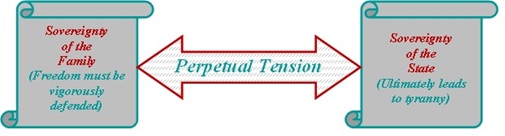
Families tend to break down as a result of a constellation of selfish decisions supported, facilitated, and encouraged by the government (divorce, abortion, euthanasia, infanticide, assisted suicide, career before family, allowing “strangers” to raise our children, uncontrolled personal debt, increasing dependence upon government and progressive dilution of the definition of what constitutes a family). While the clergy traditionally fights to preserve the family, the modern American government fights to destroy it.
Families and individuals living in a Judeo-Christian based culture seek to put others before self. Although doing so is a lifetime journey, the ongoing effort harmonizes many interpersonal relationships and much of society, even among those who are not adherents to Judeo-Christian tradition.
When a culture such as the United States moves from a faith in God to a faith in evolution-rooted humanism, it migrates from an emphasis on serving others to serving self, producing sharp and dramatic increases in the most selfish decisions of all—those involving life and death.
Choices forbidden for millennia in Judeo-Christian and most other cultures first become legalized, and a short time later endorsed and even facilitated by active government promotion and financial support. The most selfish decisions ever made include divorce, abortion, euthanasia, allowing strangers to raise a married couple’s children, and prematurely side-barring inconvenient relatives in institutions such as nursing homes. In a declining culture, those horrible, heart-wrenching decisions become the new norm. Many so called government-sponsored “entitlement programs” effectively promote wrongdoing (sin) by subsidizing it.
When Self reigns supreme, there is no limit to the evil that can be perpetrated by one person on another. At the national (cultural) level, the evil is readily cloaked in appealing language such as “pro-choice” or “death with dignity.”
No civilization has ever survived the breakdown of the family!
What do you think?
Share this:

Husbands, Would Your Wife Rather Be Home? Encourage Her!
The modern American culture has swerved so far away from the 7-millennium long traditional family-centered culture to the current career-centered culture that young women are virtually forced by cultural pressure to pursue a career as a higher priority than the family. Some have claimed it is possible to have it both ways. The reality is that more and more women are discovering that by definition there can only be one priority. If the priority is career, the family will suffer now and later.
Many women would genuinely prefer to be a homemaker. But those who are brave enough to face the wolfish cultural pressure may be confronted by another barrier closer to home. Today, many married men presumptively expect their wives to have a money-earning job outside the home.

Traditionally—at least up until a few decades ago—men would be embarrassed if their wives worked outside the home. The men were proud of their ability to provide for the material needs and the security of their home. In just a few short decades, their pride succumbed to radical feminist pressures and transitioned to, “Honey, it’s OK to get a job if you want to; either way is OK with me.” The laisse-faire attitude, which was often interpreted by women as uncaring eventually became today’s, “Honey, you MUST have a job to help pay all of the bills.”
Severe cultural pressures and often poor financial planning create formidable barriers for the would-be homemaker. Here’s the rub! Men, if any of you are pressuring your wife to pursue a career, rather than encouraging her to be a homemaker, God has a very direct and stern warning for you. As you read the quote in three translations, remember, “The fear of the Lord is the beginning of wisdom:”
- “The women of my people have ye cast out from their pleasant houses; from their children have ye taken away my glory forever. Arise ye, and depart; for this is not your rest: because it is polluted, it shall destroy you, even with a sore destruction.” [Micah 2:9-10 King James Version]
- “You drive the women of my people from their pleasant homes. You take away my blessing from their children forever. Get up, go away! For this is not your resting place, because it is defiled, it is ruined, beyond all remedy.” [Micah 2:9-10 New International Version]
- “You throw my people’s women out of the homes they love. You deprive their children of my glory forever. Get up and go! You can’t stay here! Because [the land] is now unclean, it will destroy you with a grievous destruction.” [Mikhah 2:9-10 Complete Jewish Bible]
The clarity of the three scripture translations is inescapable. Regardless of today’s cultural pressures, a husband must not encourage his wife to pursue a job outside the home. Whether or not she actually does is another discussion. However, first consider this:
God views the entirety of history as a continuum from Creation through the coming of the Messiah. He sees a holistic master portrait. That portrait includes a seamless parade of generations, each receiving the baton of civilization from the previous generation and passing it on to the next generation. At least that is His intent.
The woman as wife and mother is the link between generations. She learns from the previous generation, primarily from her mother, gives birth to the next generation, and is primarily responsible for nurturing and raising the next generation to become men and women of strong character, capable of carrying the baton of civilization onward to the following generation. She is ultimately responsible for the cohesiveness of the family and the sustainability of the culture.
The passage in Micah 2:9 indicates that when the homemaker is “cast out,” driven out, or thrown out of the home, to pursue material goals, the missing link forms a disconnect in the flow of generations and the preservation of civilization. The disconnect deprives the children of God’s glory for a very long time—the passage says, “forever.”
Visualize the disconnect as a seamless hand-knit sweater. When a single piece of yarn is broken, a slight tug causes the entire sweater to unravel. Similarly, the entire fabric of America unravels and is rapidly unraveling today when the family link in time is broken. Wow! That’s heavy; think about it for a few moments.
The greatest expression of love between a married man and woman is the birth of a child. New parents often cry out, “It’s a miracle from God!” and so it is. The child remains every bit as much a miracle at ages 2, 5, 10, 16 or beyond. The miracle child is on loan from God throughout the growing years. God has assigned the enormous responsibility to the parents, primarily the mother, to care for and raise His created miracle to become an adult of strong character who will continue to honor God and pass along an improved baton to the following generation. How could anything be a higher priority?
God places very high and challenging expectations on the woman. Her husband’s job is to make her job easy. One day, the parents causing or contributing to a disconnect at the expense of the children will be accountable to God. If that is you, what will you say, when God asks, “What did you do with my miracle?”
Share this:

Education in Middle Ages Far More Demanding Than Today
Higher education during the Middle Ages was no joke. It was intense perhaps at times even brutal. But it developed the wholeness of a person to be humble before God and to be a positive influence on others. For example, before beginning higher education at Oxford University, Richard of Wallingford (1292-1336) was expected to have mastered reading, writing, and speaking Latin. Throughout a three to four year journey to a bachelor of arts degree Richard was required to master the trivium (first three of the seven liberal arts), i.e. grammar, dialectic (logic), and rhetoric. The grammar was a particularly rigorous style of Latin. Dialectic was very advanced logic. Rhetoric included polished oratory, learning to construct arguments and the correct form for writing letters.35 Bachelor’s level, courses taught:
- Grammar-how to write
- Dialectic-how to think
- Rhetoric-how to speak well and persuasively

Graduation required passing an aggressive oral exam and submission of a certificate of good character and morals. The process educated the whole person for the purpose of being a better person and a positive role model for others, goals largely unknown in modern schools, lost in the intellectual overemphasis on a career-building academics.
Becoming a master of the arts required another three years of intense study during which Richard would learn the last four of the seven liberal arts known as the quadrivium, the mathematics component. They included arithmetic, geometry, music, and astronomy. In addition, he would learn the three branches of philosophy—natural philosophy (intellectual), ethics (emotional), and metaphysics (spiritual).36 Far beyond basic calculations, arithmetic of the time included algebra and theoretical mathematics, a broad term that included a study of prime numbers and perfect numbers. Today, the discipline is more often referred to as number theory. Geometry included an in-depth study of the massive works of Euclid. Music had little to do with learning music performance. Instead, students focused on the theory of harmony and an “appreciation of the rhythms of the universe.” 37 The study of astronomy was equally rigorous, despite the erroneous notion that the earth was the center of the solar system and all other bodies orbited around the earth. The educational process was extremely rigorous. Nothing about it would support the claim that this was the “Dark Ages.”
Moving forward, the holistic educational process integrated knowledge, morals, and religion continually through the earliest American settlements and the founding of the United States until just the last few decades. Major universities, including most of those known today as Ivy League schools were founded to prepare young people for the ministry. Harvard University proudly proclaimed, “Let every student be plainly instructed and…consider well, the main end of his life and studies is to know God…” and required students to read the Scriptures twice a day. Yale University proclaimed, “Above all, have an eye to the great end of all your studies, which is to obtain the clearest conceptions of Divine things and to lead you to a saving knowledge of God…” and required all scholars to “…live a religious and blameless life according to the rules of God’s Word…” Princeton University required every student to attend daily morning and evening worship. What do you think?
Share this:

Education and Religion Are Inseparable!
Scripture assigns to parents the primary responsibility of educating their children [Deuteronomy 12:10 and Proverbs 4:1-7]. That assignment directly from God has never changed. In time, the parents were aided by religious institutions assuring a seamless character building process from birth to adulthood and beyond. Eventually, government schools assumed the responsibility for educating the children. Initially, the government sponsored public schools supported the religious mission so well that the parents and religious institutions began to abandon much of their God-assigned responsibilities for educating the children. But, beginning in the 1960s, the government kicked God out of the schools eventually banning most forms of religious expression in schools and virtually all other public places.

Consequently, today’s public educational system is experiencing a major crisis. It has been hijacked by the liberal progressive movement and deprived of emotional and spiritual influences in order to emphasize the “academics,” in preparation for the assumed priority of career over family in the life of every rising young man and young woman. Evolution-driven materialism recognizes no other educational goals. Since evolution does not recognize the existence of a spirit of any kind and emotions are regarded as a nuisance interfering with really important things, all that is left is knowledge devoid of any real wisdom. As a result, the public school system has become heavily embedded with humanistic evolution-driven principles and worldview. There is a new evangelism in the public schools. Humanist John Dunphy proclaimed that:
“I am convinced that the battle for humankind’s future must be waged and won in the public school classroom by teachers who correctly perceive their role as the proselytizers of a new faith: a religion of humanity that recognizes and respects the spark of what theologians call divinity in every human being. These teachers must embody the same selfless dedication as the most rabid fundamentalist preachers, for they will be ministers of another sort…utilizing a classroom instead of a pulpit to convey humanist values in whatever subject they teach, regardless of educational level—preschool, day care, or large state university. The classroom must and will become an arena of conflict between the old and the new—the rotting corpse of Christianity, together with all its adjacent evils and misery, and the new faith of humanism.”
But others, far better known and respected than Dunphy loudly proclaimed starkly opposing views long before America’s founding and continuing seamlessly until recent decades. Consider this sampling:
- “I would advise no one to send his child where the Holy Scriptures are not supreme. Every institution that does not unceasingly pursue the study of God’s Word becomes corrupt…I greatly fear that the [schools], unless they teach the Holy Scriptures diligently and impress them on the young students, are wide gates to Hell.” Martin Luther
- “[T] Bible…should be read in our schools in preference to all other books.” Dr. Benjamin Rush
- “The only foundation for useful education in a republic is to be laid in religion.” Thomas Jefferson
- “Religion is the only solid basis of good morals; therefore education should teach the precepts of religion, and the duties of man toward God.” Gouverneur Morris
- “Education is useless without the Bible.” Noah Webster
- “Religion and virtue are the only foundations, not only of all free government, but of social felicity under all governments and in all the combinations of human society.” John Adams
- “Of all the dispositions and habits which lead to political prosperity, Religion and morality are indispensable supports. In vain would that man claim the tribute of Patriotism, who should labor to subvert these great Pillars of human happiness, these firmest props of the duties of Men and Citizens.” George Washington
- Education without values, as useful as it is, seems rather to make man a more clever devil. C. S. Lewis
Children in the American government-controlled public schools devote twelve of their most vulnerable years learning to demand rights and not accept responsibility for much of anything, while being indoctrinated in the devastating self-centered evolution-driven principles of humanism. Those going on to college spend an additional four years raising to the professional level their abilities to demand rights and avoid personal responsibilities.
Values will always be taught. Nature abhors a vacuum. When selfless Judeo-Christian values are banned, the self-serving humanist values will fill the vacuum. Several decades of experience with humanistic values have produced tragic results. More in an upcoming blog. For now, what do YOU think?
Share this:

Classic Movie: The Ten Commandments-Sephora Compares Biblical/Secular Values for Moses
After being banned from Egypt, Moses barely survives a devastating trek across the desert wilderness. He is rescued by a group of shepherd girls, daughters of Jethro, a Midianite priest. Just before their marriage, one of the girls, Sephora [Yvonne De Carlo] profoundly compares traditional and secular values for Moses [Charlton Heston]. Moses has just described an Egyptian woman looking “as beautiful as a jewel.”

Sephora: “A jewel has brilliance, but gives no warmth.
- Our hands are not so soft but they can serve.
- Our bodies are not so white, but they are strong.
- Our lips are not perfumed, but they speak the truth.
- Love is not an art to us; it is life to us.
- We are not dressed in gold and fine linen; strength and honor are our clothing.
- Our tents are not the columned halls of Egypt, but our children play happily before them.
- We can offer you little, but we offer all we have.”
Moses: “I have not little, Sephora; I have nothing.”
Sephora: “Nothing from some is more than gold from others.”
The conversation between Sephora (Greek form of Zipporah) and Moses just prior to their wedding is a clear contrast between:
- traditional Biblical values, focusing on strong character and serving others (overcoming pride), and
- secular values that recognize little significance in character and seeks to serve self (feeding pride and magnifying materialism).
Which would you marry? …the wealthy and materialistic, but shallow and self-centered Egyptian girl or the shepherd girl who understands the importance of virtue and strong character and is committed to a life of loving (serving) others.
- Traditional Biblical values emerge from the wholeness of one’s soul as a conduit for God’s enduring love.
- Evolution-rooted secular values, failing to recognize the reality of a spirit and limiting emotional considerations to Hedonistic highs/lows, emerge from primarily intellectual utilitarian considerations. The latter is a humanistic deification of man, based on the assumption that evolution has reached its highest current level in the human reasoning.
Which would you choose? “As for me and my house, we will serve the Lord.”
Share this:

The Birth of the Light of the World
The Christmas season reminds us of some curious lyrics about love and light, in the most enduring Christmas carols. A closer look reveals that the curious lyrics are rooted in Scripture. Consider two examples:
- Silent Night, Holy Night-3rd verse
Silent night, holy night Son of God, love’s pure light Radiant beams from Thy holy face With the dawn of redeeming grace Jesus, Lord, at Thy birth
- Hark the Herald Angels Sing-3rd verse
“Light and life to all He brings…”
There is a linkage between love and light and something very special about the linkage. Light has fascinated mankind since Creation; artists and scientists have had a complementary interest in studying light. But the highest source of information is Scripture. A look at what Scripture reveals about love and light may save artists and scientists considerable time and effort. We can do that right now:
- “God is light; in him there is no darkness at all.” [1 John 1:5 NIV]—All electromagnetic energy that we perceive as light comes from the Sun. Since the light that illuminates the eyes was created by God, He is the physical light. God is also the spiritual light that illumines the soul.
- “…God is love…” [1 John 4:16 KJV] and “…love comes from God.” [1 John 4:7 KJV]—Love is spiritual energy that comes from God, illuminates the soul, and fuels all interpersonal relationships. All love comes from God, whether the one loving gives God credit or not. Our greatest responsibility is to pass it on.

The visible earthly expression of God’s love is in and through the Son (Jesus, Y’shua). He provided “…a light for revelation to the Gentiles and for glory to your people Israel.” [Luke 2:32 NIV] “In him was life, and that life was the light of men…The true light that gives light to every man was coming into the world.” [John 1:4 & 9 NIV]
After forgiving the adulteress, Jesus (Y’shua) confirmed “…’I am the light of the world. Whoever follows me will never walk in darkness. But will have the light of life.” [John 8:12 NIV]
Albert Einstein was famous for thought experiments. As a young man, he imagined riding a beam of light. Of course, Jesus could not ride a beam of light; he is the light. Instead, he chose to arrive in a stable through the humble darkness of a virgin’s womb. He was laid in an animal’s feeding trough called a manger. For 33 years, the “King of the Jews” lived a humble life serving others, ultimately exiting this life in the humblest way possible, dying virtually naked on the excruciatingly painful Roman cross.
King Jesus (Y’shua) came as a humble servant to model the life God intended for us to live and to pay the penalty for Adam’s first sin and all the sins in your life and mine. One day, the King will return as the conquering Messiah.
Don’t be afraid of any form of darkness; God is the light! Don’t fear any form of threat; God is love!
As for me, “The Lord is my light and my salvation…” [Psalm 27:1 NIV]
Won’t you join me?
Share this:

What Do Jews Think About Christmas Celebrations?
Nearly all Americans (93%) celebrate Christmas. Only an extremely tiny minority would object to the greeting, “Merry Christmas,” a cherry greeting roughly equivalent to, “I love you,” Yet, political correctness, championed by the liberal/progressive movement, has effectively eliminated the Merry Christmas greeting from public life as well as nativity scenes and other symbols of Christmas.

In contrast, consider what three nationally-known Jewish leaders have to say about Christmas celebrations:
Burt Prelutsky, a Jewish columnist for a number of national publications, declares:
I never thought I’d live to see the day that Christmas would become a dirty word. . . . How is it, one well might ask, that in a Christian nation this is happening? . . . Speaking as a member of a minority group – and one of the smaller ones at that – I say it behooves those of us who don’t accept Jesus Christ as our savior to show some gratitude to those who do, and to start respecting the values and traditions of the overwhelming majority of our fellow citizens, just as we keep insisting that they respect ours. Merry Christmas, my friends!
Orthodox Jewish Rabbi Daniel Lapin agrees:
Secular fundamentalism has successfully injected into American culture the notion that the word “Christmas” is deeply offensive. . . . Anti-Christianism is unhealthy for all Americans; but I warn my brethren that it will prove particularly destructive for Jews. . . . Let us all go out of our way to wish our many wonderful Christian friends – a very merry Christmas. Just remember, America’s Bible belt is our safety belt.
Orthodox Jewish radio host and creator of PragerUniversity.com Dennis Prager writes:
As a Jew, and a religious one at that, I want to wish my fellow Americans a Merry Christmas. Not “Happy Holidays.” Merry Christmas…
It doesn’t matter with which religion or ethnic group you identify; Christmas in America is as American as the proverbial apple pie. That is why some of the most famous and beloved Christmas songs were written by guess who? Jews.
- White Christmas—Irving Berlin
- Rudolph, the Red-Nosed Reindeer—Johnny Marks
- Let It Snow! Let It snow! Let It Snow!—July Styne/Sammy Cahn
- Silver Bells—Jay Livingston/Ray Evans
- The Christmas Song (Chestnuts roasting on an Open Fire—Mel Torme/Robert Wells
- Sleigh ride-–Mitchell Parish
and many others.
The notion that non-Christians are excluded is absurd.
It never occurred to my Orthodox Jewish family not to enjoy this season. It was a tradition in our home to watch the Christmas Mass from the Vatican every Christmas Eve…Had you visited our home, you would have seen my mother—and my father, my brother and I all wearing our kippot (Jewish skull-caps)—watching Catholics celebrate Christmas…
So when and why did this pernicious nonsense of non-Christians being “excluded” by public celebration of Christmas develop?
It is nothing more than another destructive product of the 1960s and 1970s, when the left came to dominate much of the culture.
There you have it! Say “Merry Christmas” everywhere; say it again and again and again. Say Merry Christmas with love every time. Saying it mechanically, without love betrays the greeting and the Lord.

So—Spread the Deliberate Joy; spread the merriment. After all, love is contagious. And—don’t forget the reason for the season!
Blogging YOU the warmest and merriest Christmas ever!
The first two quotes were abstracted from http://www.wallbuilders.com. The third quote is from wnd.com magazine, Whistleblower, “Of Messiahs False and True,” December 2014.
Share this:

Big Government is NOT Sustainable
Of course much of small government discussion in a recent blog is viewed as irrelevant by people who are skeptical of the Bible and whose life is largely driven by the theory of evolution. Since people are assumed to be merely the highest evolved animal, it appears reasonable for the best and brightest to be given whatever authority is necessary to make decisions for the masses and whatever resources are necessary to execute their authority. Hence, the virtually uncontrolled expansion of big government:
- There is never enough power or money to satisfy the ego and pride of people in control.
- In the absence of spiritual and emotional influences, decisions tend to be made on a cold practical utilitarian basis, unshackled by the notions of purpose or principle.
- Individual freedom is progressively lost as government demands more and more power.

The power continues to concentrate and government grows until it becomes unsustainable Totalitarian power becomes the inevitable endpoint. The relentless drive to achieve uniformity and “fairness” stifles individual creativity. A major problem is that fairness like beauty is in the eyes of the beholder. There is simply no universally agreed upon definition or standard of fairness. Nevertheless, the notion of fairness continues to resonate well with many voters. In contrast, the Scriptural standard is an integration of judgment and mercy. When the two concepts are in opposition, mercy wins. “…mercy rejoiceth against judgment.” [James 2:13 KJV]
Big Government is evoked by evolution.
- People are controlled by government; power is dispensed by government as “rights” or “benefits.”
- The supporting propaganda is generally unrestricted, because many of the promoters have bought into postmodern thinking, which maintains that there is no absolute truth.
- Big government advocates tend to promote their views with emotion, because the facts of history lead to the inescapable conclusion that small government is better, and because the emotion obscures the cancerous growth of government and feeds the notion that people can get an endless list of freebies from the government.
When YOU compare small government and big government what conclusions to you draw?
Share this:

American Exceptionalism Exists! You May Not Know Why.
References to American exceptionalism have recurred with increasing frequency in recent years. Some champion the notion; Russian President Vladimir Putin has recently scoffed at it on several occasions, regarding it as a representation of American arrogance. American exceptionalism arose because a critical mass of Americans looked to God as the source of everything for the first 150 years of United States history.

Because Americans looked to God and loved God they enjoyed His abundant blessings. Americans were blessed with the ability to generate the world’s highest standard-of-living and best quality-of-life. America became the standard of freedom and the envy of people around the globe. People everywhere wanted to become Americans, be like Americans, or copy American styles and fads. America was a leader and a positive role model for the world. Spectacular military successes in two world wars and incomparable economic successes simply reinforced the image of American exceptionalism.
But in recent decades as Americans have increasingly abandoned God His hand of blessing has receded. America’s worldwide reputation for outstanding leadership has been shattered. Leaderless America wanders in a spiritual wilderness, shamelessly and repeatedly elects a government that squanders vast financial and material resources, and has become a worldwide negative role model that regretfully attracts as much attention as did the previous reputation for being a positive role model. People throughout the world still follow America’s downward spiral with as much gusto as they followed America’s upward climb to greatness. America’s influence extends far beyond its shores whether for good or evil.
But without God, Americans are no better than anyone else. American exceptionalism arose not because Americans are exceptional but because God is exceptional. He still is. Does American exceptionalism still exist? You decide. If you lean toward, “no,” know that God is still exceptional. American exceptionalism can again become abundantly visible to the world only to the extent that Americans become once again willing to trust God and to love God. Are YOU willing to become part of it? Individuals of Judeo-Christian tradition and faith-based institutions can no longer be content to rearrange the deck chairs on the rapidly sinking American Titanic.
Share this:

Homemaker Enjoys The Most Important Career in the Universe!
A Homemaker enjoys the most influential and vital career in the universe. She is responsible for the stability of a culture and the cohesiveness of the family. She is the panoramic link in time, connecting the generations. She links the past to the future, ancestors to descendants. She is primarily responsible for raising the children in a manner that stabilizes their future and transmits critically important values to the next generation. In short, she makes the home the most desirable place in the universe for her family.
When the homemaker leaves the home, love leaves like air out of a flat tire. The home becomes the house, little more than the building where everyone comes to sleep at night.

Consider the fruit of a family-centered family as opposed to a career-centered family:
- Builds strong cohesive families when Dad is responsible for standard-of-living and Mom is responsible for quality-of-life
- Promotes a partnership between married men and women that grows closer with time
- Children reared by those who love them most…Mom and Dad
- Low risk monogamous sex provides for pleasure and reproduction
- Number and frequency of venereal diseases sharply reduced and largely eliminated
- Few abortions, because the unborn child is an expression of the parents’ love
- One man; one woman; one lifetime is the stable marriage norm accepted for six millennia
- Men and women both desire the stability of marriage
- Stable relationships between a man and a woman due to the certainty of the marriage commitment
- Infrequent divorce due to love and respect for spouse as well as responsibility for children
- Legacy of cultural stability passed on to successive generations
- Children experience and enjoy the complementary influences of a mom and a dad
- “Alternative lifestyles” viewed as against nature, culturally destructive, and inappropriate especially when children are involved
- Children are more stable, less stressed, more secure, and behavior is more predictable and…when necessary…more controllable
- Husband and father is vital to the well-being of the family
- Preserves and reinforces the sanctity of life and sanctity of marriage
- Protects and reinforces the sovereignty of the family
- Lifestyle evokes a happier and healthier woman and strong family relationships
What do you think? Have we lost something vitally important in our modern American culture?
Share this:

American Founders Endowed with Uncommon Wisdom!

In recent years, it seems to have become open season on the American Founders. Some have scornfully described the Founders as dead white guys who owned slaves. Well—they’re certainly dead; they were white; and only a few owned slaves and the ones that did, didn’t like the institution. Such will be a topic of another blog. The Founders were actually endowed with uncommon wisdom. To understand them, it is far better to read what they actually said, rather than what some historian may have concluded about them. My upcoming book allows the Founders to speak for themselves. For now, let’s consider the words of just one of them, John Adams. He was a Founder, signer of the Declaration of the United States, Vice President under George Washington, and the second President of the United States.
- June 21, 1776 “Statesmen, my dear Sir, may plan and speculate for liberty, but it is Religion and Morality alone, which can establish the Principles upon which Freedom can securely stand.” “The only foundation of a free Constitution is pure Virtue, and if this cannot be inspired into our People in a greater Measure, than they have it now, they may change their Rulers and the forms of Government, but they will not obtain a lasting liberty.”
- July 1, 1776 “Before God, I believe the hour has come. My judgment approves this measure, and my whole heart is in it (Declaration of Independence). All that I have, and all that I am, and all that I hope in this life, I am now ready here to stake upon it. And I leave off as I began, that live or die, survive or perish, I am for the Declaration. It is my living sentiment, and by the blessing of God it shall be my dying sentiment. Independence now, and Independence forever!“
- In a July 1, 1776 letter to Archibald Bullock, former member of the Continental Congress from Georgia, Adams wrote: “The object is great which We have in View, and We must expect a great expense of blood to obtain it. But We should always remember that a free Constitution of civil Government cannot be purchased at too dear a rate as there is nothing, on this side (of) the New Jerusalem, of equal importance to Mankind.”
- July 3, 1776 “The second day of July, 1776, will be the most memorable epoch in the history of America. I am apt to believe that it will be celebrated by succeeding generations as the great anniversary Festival. It ought to be commemorated, as the Day of Deliverance, by solemn acts of devotion to God Almighty. It ought to be solemnized with pomp and parade, with shows, games, sports, guns, bells, bonfires and illuminations, from one end of this continent to the other, from this time forward forever. “You will think me transported with enthusiasm, but I am not. I am well aware of the toil and blood and treasure that it will cost to maintain this Declaration, and support and defend these States. Yet through all the gloom I can see the rays of ravishing light and glory I can see that the end is worth more than all the means; that posterity will triumph in that day’s transaction, even though we [may regret] it, which I trust in God we shall not.”
- In concern for his sons, John Adams advised his wife Abigail to: “Let them revere nothing but Religion, Morality and Liberty.”
- 11, 1798 (Address to the military) “We have no government armed with power capable of contending with human passions unbridled by morality and religion. Avarice, ambition, revenge, or gallantry, would break the strongest cords of our Constitution as a whale goes through a net. Our Constitution was made only for a moral and religious people. It is wholly inadequate to the government of any other.”
- On November 2, 1800, John Adams became the first president to move into the White House. As he was writing a letter to his wife, he composed a beautiful prayer, which was later engraved upon the mantel in the state dining room: “I pray Heaven to bestow THE BEST OF BLESSINGS ON THIS HOUSE and All that shall hereafter Inhabit it, May none but Honest and Wise Men ever rule under This Roof.”
- August 28, 1811 “Religion and virtue are the only foundations, not only of all free government, but of social felicity under all governments and in all the combinations of human society.”
- June 28, 1813 “Now I will avow, that I then believe, and now believe, that those general Principles of Christianity, are as eternal and immutable, as the Existence and Attributes of God; and that those Principles of liberty, are as unalterable as human Nature and our terrestrial, mundane System.”
- In a letter to Thomas Jefferson, John Adams wrote: “Have you ever found in history, one single example of a Nation thoroughly corrupted that was afterwards restored to virtue?… And without virtue, there can be no political liberty….Will you tell me how to prevent riches from becoming the effects of temperance and industry? Will you tell me how to prevent luxury from producing effeminacy, intoxication, extravagance, vice and folly?…I believe no effort in favor is lost…“
- In a letter dated November 4, 1816, John Adams wrote to Thomas Jefferson: “The Ten Commandments and the Sermon on the Mount contain my religion…“
- December 27, 1816 “As I understand the Christian religion, it was, and is, a revelation.” “Liberty cannot be preserved without a general knowledge among the people, who have…a right, an indisputable, unalienable, indefeasible, divine right to that most dreaded and envied kind of knowledge, I mean the character and conduct of their rulers.”
Do you agree that at least this Founder was endowed with uncommon wisdom?
Share this:

God Modeled His Circle of Love for YOU!
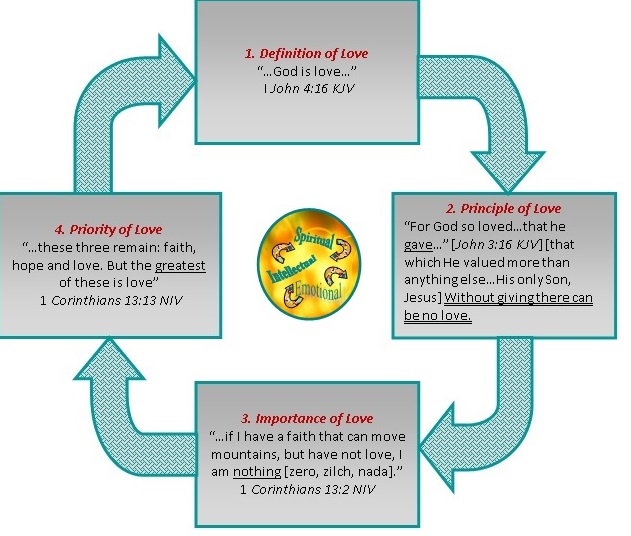
Very simply, “…God is love…” [1 John 4:16 KJV]. That’s it! Love is defined in just three little words, with no qualifiers. Now that does not sound very romantic does it? It certainly doesn’t sound very Hollywoodish. But there you have it in three simple words: God is love. The implications are profound. Love is the basis and driving force for ALL interpersonal relationships, including man-woman, parent-child, boss-employee, teacher-student, friend-friend, and neighbor-neighbor. The standout differences that distinctively set apart the marriage relationship include its intensity, depth, level of intimacy, and permanence. However, all relationships are built on love. Relationships grow to the extent that love grows; relationships weaken or terminate to the extent that love weakens. Love is so important to individuals, interpersonal relationships, and ultimately to cultures that a closer look is inescapable.
Consider Step 2 of the circle, the Principle of Love. Since all love originates from God, He is the best and only totally reliable source of wisdom regarding the practice of love. Although most people tend to focus on the back end of the best known and loved verse in the Bible, to understand the principle of love it is necessary to zoom in on the front end. “For God SO loved…that He GAVE…” [John 3:16 KJV] God loved us and all of His creation to such a great extent that He gave. What did He give? He gave that which He valued more than anything else “…His only begotten Son,” Jesus Christ who died on a brutal Roman cross to pay the penalty for the sins of all mankind. Since Scripture gives evidence that God is three persons in one, often called the Trinity, (God the Father, God the Son, and God the Holy Spirit) He effectively volunteered to give Himself as the ultimate expression of love.
Clearly, without giving there can be no love. Love and all relationships grow to the extent that there is regular giving. Love and relationships weaken or terminate when giving slows or stops. The marriage relationship has one distinct difference. It is intended and decreed by God to be permanent regardless of internal circumstances. It can be a loving marriage or a loveless marriage as the husband and wife choose, but either way it is permanent. “Therefore, what God has joined together, let man not separate.” [Mark. 10:9 NIV] Look for much more about the marriage concept in upcoming blogs. Love is always dynamic; it is never static. It cannot stand still; it will either grow or weaken as time passes.
Since God is love, what does He have to say about the importance of love? 1 Corinthians 13:2 [NIV] clearly underscores the Importance of Love in my life and yours. “…if I have a faith that can move mountains, but have not love, I am NOTHING.” (zero, zilch, nada) I learned long ago that zero is a very small number. The brightness of God is shining inescapably on the view that if my life and yours are not clearly characterized by love, as evidenced by continuous giving, we are wasting the awesome and precious gift of life that God has given us.
Since love is critically important to a rich life experience, it should be no surprise that God gives it the highest of all priorities. Step 4 of God’s Circle of Love cites 1 Corinthians 13:13 [NIV], “…these three remain: faith, hope and love. But the greatest of these is love.” Whoa! How can love be the greatest? Does not faith “unlock the door” to heaven, our preferred eternal destiny? Isn’t eternity more important than the fleeting temporary life here and now? Of course it is! However, Scripture says that love is greater than faith or hope simply because “God is love,” thus closing God’s Circle of Love. Love drives all relationships. As a practical matter, a love-driven life reduces stress thus enriching all of life’s experiences.
Share this:

Can an Unbeliever Make a Credible Movie About a Biblical Event?

The short answer? No! Throughout the 1950s, there were a number of highly successful Biblical epics made by Hollywood. The most spectacular was Cecil B. DeMille’s, The Ten Commandments. After a very long hiatus, the spectacular success of The Passion of the Christ renewed Hollywood’s interest in Bible-based movies. Recently, a movie called Noah was released and another, Exodus: Gods and Kings is nearing release. Both were made by directors who claim to be atheist or agnostic. Let’s Compare.
At the beginning of the movie, The Ten Commandments, director Cecil B. DeMille did something remarkable. He walked out on a stage to preface the movie with a few heartfelt comments:
Ladies and Gentlemen; young and old; this may seem an unusual procedure, speaking to you before the picture begins, but we have an unusual subject: the story of the birth of freedom; the story of Moses. As many of you know the Holy Bible omits some thirty years of Moses’ life, from the time that he was a three- month old baby and was found in the bull rushes by Bithiah the daughter of Pharaoh and adopted into the court of Egypt until he learned that he was Hebrew and killed the Egyptian. To fill in those missing years, we turn to ancient historians such as Philo and Josephus. Philo wrote at the time that Jesus of Nazareth walked the earth; Josephus wrote some fifty years later and watched the destruction of Jerusalem by the Romans. These historians had access to documents long since destroyed or perhaps lost like the Dead Sea Scrolls. The theme of this picture is whether men ought to be ruled by God’s laws or whether they are to be ruled by the whims of a dictator like Rameses. Are men the property of the State or are they free souls under God? This same battle continues throughout the world today. Our intention was not to create a story, but to be worthy of the divinely inspired story created 3,000 years ago in the five books of Moses.
DeMille’s understanding of the importance of God’s laws was further clarified in the souvenir book distributed along with the movie:
The Ten Commandments are not rules to obey as a personal favor to God. They are fundamental principles without which mankind cannot live together—THE TEN COMMANDMENTS are not laws. They are THE LAW. Man has made 32,000,000 laws since they were handed down to Moses on Mount Sinai more than three thousand years ago, but he has never improved on God’s law.
The movie was clearly DeMille’s labor of love.
In contrast, a movie entitled Noah, about the Biblical worldwide flood was recently released. The director, Darren Aronofsky, is a self-proclaimed atheist. He departed widely from the Biblical account portraying Noah as the first great environmentalist and not mentioning God at all despite over ten references to God in the original. Another movie, Exodus: Gods and Kings is nearing release. The director Ridley Scott, is a self-acknowledged agnostic. Christian Bale the leading man has on separate occasions referred to Moses as schizophrenic and a terrorist. Scott’s rendering has God speaking to Moses through an angry child, rather than the burning bush and at least a few supernatural events, such as the Nile River turning to blood, are explained in natural terms. In the case of the Nile, a non-Biblical plague of crocodiles feeds on people whose blood turns the river red.
Can an evolution-driven humanistic director possibly make a God-honoring movie when he disavows the existence of God? The Ten Commandments was made to glorify God; the modern depictions of Noah and Exodus: Gods and Kings were made to glorify Hollywood and the creativity of man. Cecil B. DeMille felt morally and spiritual bound to present Biblical history as accurately and respectfully as possible. Aronofsky and Scott claim no such allegiance. To them, the Biblical “stories” are merely a starting point. They feel free to depart from Scripture as often and as widely as they choose to achieve their goal of an agenda-filled entertaining movie. The state-of-the-art is such that the modern movies can be wildly entertaining but at what price?
Flashback! For decades preceding World War II, Hollywood elites were fascinated supporters of Joseph Stalin and communism in general. The pre-war communist influence in Hollywood has been well documented. At that time, American Communist Party leader Earl Browder discouraged the making of propaganda films. Instead, he encouraged movie makers to slip in “a drop of progressive thought” in regular movies, about five minutes in each movie. In the decades since WWII, Hollywood continued and still does have a love affair with socialism, which is communism-lite. The agendas in Noah and Exodus: Gods and Kings are clear. Despite the entertaining nature of the movies, the makers want to discredit Judo-Christian tradition by displacing it with humanist values and goals.
In 1956, Cecil B. DeMille billed his movie, The Ten Commandments, as the story of “the birth of freedom.” It was the story of the Moses-led exodus of the ancient Israelites, following 400 years of slavery in Egypt. Many centuries after the Hebrews were freed from Egyptian bondage, that God-given freedom was codified successively in the Magna Carta (1215), the Mayflower Compact (1620), the Fundamental Orders of Connecticut (1639) and the Constitution of the United States (1787).
It is difficult to avoid billboards. But YOU get to choose movie, television, and Internet experiences. All are powerful art forms, powerful because they reach the depths of the soul branding an imprint in a powerful and lasting way. No art form is neutral; it will either lift the soul toward God or drag the soul down. There is no movie, television show, or Internet experience that is just entertainment and nothing else. Even if the art form does not have an explicit agenda, it absolutely does reflect the worldview of its creator. As they say in the radio editorials, “That’s our view; we welcome yours.”
Share this:

The Thanksgiving Miracle of Five Kernels of Corn

Most of us learned about Thanksgiving in school. You know the drill. In 1620, the Pilgrims crossed the ocean blue and experienced a devastatingly harsh winter along the Massachusetts coast. About half of them perished. Spring finally arrived and a friendly Indian named Squanto helped the Pilgrims learn how to obtain food by stomping eels out of the mud and fertilizing corn with dead fish. The following fall, they celebrated an abundant harvest with a feast that became known as the first Thanksgiving. But there is more, much more. The string of miracles is nearly endless:
- Many years before, the Separatists, later known as the Pilgrims, reached the breaking point of frustration and disappointment after enduring severe persecution by the Church of England. They “removed” to Leyden, Holland. After nearly a dozen years of severe adversity and personal toughening, it was time to leave. They came to believe the America was their “promised land.” They found their way back to England on the ship, Speedwell, prepared to join the Mayflower for the long difficult voyage to America. At Southhampton, their sponsors forcibly required them to accommodate 80 “strangers” who would later strain the best of interpersonal relationships. The Pilgrims numbers were reduced due to limited capacity on the ships. In July, 1620, they sailed west. In barely three days they had to return to England, because of structural problems with the masts on the Speedwell. Again, their numbers were reduced to stay within the carrying capacity of the Mayflower. God had sifted their numbers repeatedly. Only the hardiest of the hardy remained on the Mayflower for the epic journey.
- Crossing the Atlantic Ocean, the Pilgrims endured “seven weeks of the hell of an ill-lighted, rolling, pitching, stinking inferno” as well as tormenting by the crew. All manner of sins were brought to the surface, confessed, and forgiven. By the time they reached land, they were a spiritually cleansed and extremely close-knit group. Adversity does that.
- Mid-way across the Atlantic, they experienced a life-threatening emergency. The immense cross-beam supporting the main mast was failing. They would likely be lost at sea. After intense prayer, William Brewster had a eureka moment. He recommended using the giant iron printing press screw to support the breaking beam. It worked! Even the skeptical sailors praised God along with the Pilgrims.
- Just before landing at Plymouth in Massachusetts, they realized they were under no legal jurisdiction. To maintain order, they wrote and everyone signed the Mayflower Compact. The miracle and genius of the document is that it included many of the same principles later embodied in our founding documents.
- Their landing site was protected by Cape Cod. The site was flat, cleared, and had four freshwater streams and even a cache of corn. How could that happen? The area was previously cleared and inhabited by the Patuxet Indians, one of the few tribes known to be extremely hostile. Years before the Pilgrims’ arrival, the tribe was wiped out by a plague. Other tribes avoided the area, fearing presence of evil spirits. It was a miracle site for the Pilgrims.
- They finally set foot on land in mid-November, 1620.The first winter was extremely harsh and food was scarce. In January, the thatched roof of the Common House caught fire, a life-threatening emergency, due to their utter dependence on that building. Adversity inspired even more prayer and bound them together even tighter. By Spring, they had lost about half their number. Still the mortality rate was not nearly as high as in Jamestown, Virginia. The miracle was that half did survive.
- In their most desperate hour into their camp walked a Christian, English-speaking Indian, a Patuxet no less. Yes, you read it right. He was the Squanto of our school days lessons. He was the only survivor of the plague that killed the rest of his tribe, because he was not there. In 1605, Squanto was one of four Indians taken captive and shipped to England, where they were taught English so they could be questioned. Squanto spent nine years in England. In 1614, he was returned to America by Captain John Smith (Yes, it is the same one you remember from the Pocohontas story hundreds of miles to the South.). But Squanto was quickly captured again, taken to Spain and sold as a slave. He was bought and feed by local friars who taught him the Christian faith. Upon his second return to America, Squanto was devastated to find that his entire tribe had succumbed to a plague. Alone and wandering through the woods, Squanto was discovered by Massasoit, chief of the Wampanoags. The wise chief recognized that the Pilgrims had a desperate need and the Squanto desperately needed to be needed. Massasoit sent Squanto, the Christian, English-speaking Indian to the Pilgrims. William Brewster would later call Squanto, “a special instrument sent of God for their good, beyond their expectation.” Squanto effectively became an earthly savior. He taught the Pilgrims how to survive in a harsh, rugged, untamed wilderness.
- Following a bountiful harvest, they and about ninety Indians celebrated the feast that became known as the First Thanksgiving. The three-day celebration and the new arrivals from England consumed much of the provisions for the second winter.
- By Spring, the food ration for each individual was down to an unimaginable five kernels of corn per day. Nevertheless, they survived again and enjoyed a bountiful harvest after the second summer.
- When everyone approached the table for the Second Thanksgiving feast, they found a plate with just five kernels of corn as a reminder of God’s limitless grace even under the harshest of conditions.
Here is a challenge for you. Set this year’s Thanksgiving table with just five kernels of corn on each plate. Before enjoying the rest of the feast, share this story with your family and guests. God’s grace is truly wonderful! Tell everyone, about it, beginning with your family.
Much of this story was abstracted from The Light and the Glory, by Peter Marshall and David Manuel (1977), Fleming H. Revell Company; Old Tappan, New Jersey.
Share this:

What is Love?

Ask a number of people, “What is love?” Most will be unable to define “love,” even though nearly everyone uses the word virtually every day and often many times a day. Some people will respond with a blank stare, some with a quip (It’s like pornography; I know it when I see it.) Occasionally someone may say that, “The Bible tells you all about love in I Corinthians 13.” True, that passage does list the characteristics of love but, does not define it. Rarely does anyone get it right.
If you talk to any Christian for a few minutes on the subject of love, he/she will go on autopilot and somewhat mechanically refer you to 1 Corinthians 13. Since all Scripture is inspired, it’s great stuff. However, it is a post-graduate course in love that is seldom understood in a soul-deep, urgent, action-oriented sense, despite the thousands of sermons devoted to it. Just as some university courses have certain prerequisites, God’s graduate course in love also has prerequisites.
Very simply, “…God is love…” [1 John 4:16 KJV]. That’s it! Love is defined in just three little words, with no qualifiers. Now that does not sound very romantic does it? It certainly doesn’t sound very Hollywoodish. But there you have it in three simple words: God is love. The implications are profound. Love is the basis and driving force for ALL interpersonal relationships, including man-woman, parent-child, boss-employee, teacher-student, friend-friend, and neighbor-neighbor. The standout differences that distinctively set apart the marriage relationship include its intensity, depth, level of intimacy, and permanence. However, all relationships are built on love. Relationships grow to the extent that love grows; relationships weaken or terminate to the extent that love weakens. Love is so important to individuals, interpersonal relationships, and ultimately to cultures that a closer look is inescapable. What do you think?
Share this:

No Homemaker “Gap” in Resume

Occasionally, women who have stayed at home for a number of years to be a homemaker and mother ask me how to handle the “gap” in their resume. I tell them that there is no gap. They have served as the:
Chief Operations Officer (COO) of the home, responsible for:
- operations and maintenance of the home,
- capital improvements (remodeling),
- purchasing, budgeting, financial management, and marketing (representing the family’s interests and reputation inside and outside the home),
- managing subcontractors (plumbers, electricians, appliance repairs, yard workers, etc.),
- field operations (activities related to hobbies, sports, and places of worship),
- human resource management (inspiring and motivating family members to be productive and actively responsible),
- personnel training (raising the children with a strong sense of values), and
- environmental management (greening the home & family worldview).
Building a safe, stress free family organizational culture. Making the home the most desirable place in the universe for the family and raising offspring to become adults of strong character is a boundaryless (24/7) full time responsibility. Serving as a homemaker is much like running a small business. The multidisciplinary wisdom and management experience acquired is applicable to virtually any workplace.
If you agree with the above characterization of a homemaker, you may feel free to use it without attribution. What do you think?

 Dr. Lloyd Stebbins