Do People Ask YOU About Your Faith? Why? When?

Recently, I was reminded that Christian leaders encouraging believers to share their faith often cite 1 Peter 3:15, which reads, “Always be prepared to give an answer to everyone who asks you to give the reason for the hope that you have.” [NIV] The context of the presentation is usually an effort to persuade believers to ask a clever question, which will turn the conversation in a spiritual direction.

However, the Scriptural context is always being ready, when someone, usually an unbeliever, asks the believer about his hope. Do people ask YOU about your hope? Why or why not? The sense of the Scriptural passage is that the hope must be visible or no one would be inclined to ask.

How does hope become visible? 2 Corinthians 6:17 echoes the same thought, “Come out from them and be separate, says the Lord.” [NIV] Being separate indicates visibility; hope clearly means visibility in a positive, attractive, and encouraging way.

But today, many in the body of Christian believers are largely invisible—lost in the crowded background culture. We look like everyone else. We dress like everyone else, within limits of modesty. We talk like everyone else, but usually choose to avoid profanity. We socialize like everyone else, but avoid certain movies or particularly sinful places. However, what we don’t wear, don’t say, or places we choose not to go are negatives, which are essentially not visible. Yet, we are known as a people who aspire to live life on a higher plane. When the higher plane is not visible, the result is the common accusation that we are judgmental, narrow minded, dupes.

The vital question remains, “How are we to be separate and visible in a positive or desirable way?” Matthew 7:20 is a big help, “…by their fruit you will recognize them.” [NIV] What fruit? The fruit of godly character and the fruit of love, which is the fruit of the Spirit!

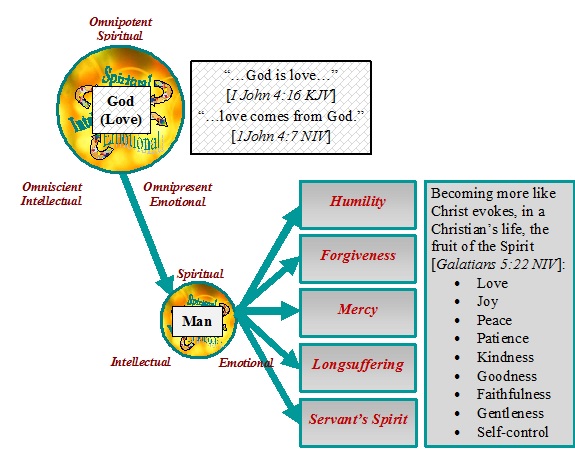
A previous blog demonstrated that love is spiritual energy and that ALL love comes from God. God’s infinite love passes through the prism of YOU and me, to the extent that it is not hindered by the interference of our pride, separating love into its components, which are humility, forgiveness, mercy, longsuffering, and a servant’s spirit. We grow and mature by actively and routinely choosing to be humble, forgiving, merciful, longsuffering, and being a servant to others. These are the actions that become visible in our culture, when we exhibit them as a lifestyle.

Love

But there is more, much more. Our character and visibility grow as we encounter opportunities to be humble, forgiving, merciful, longsuffering, and a servant to others. Character growth allows us to experience one of God’s most incredible promises, “But the fruit of the Spirit is love, joy, peace, patience, kindness, goodness, faithfulness, gentleness, and self-control.” [Galatians 5:22 NIV] All the time, during and in between character-building events, we are privileged to experience, express, and exhibit the pervasive overwhelming fruit of the Spirit.

Now, that’s positive, endearing visibility. The fruit of the Spirit creates a glow and spiritual allure unlike anything else. That’s when people will ask us about the hope that we have. That’s when YOU must, “Always be prepared to give an answer…” What do YOU think?

“Mothers constitute the only universal agent of civilization. Nature has placed in her hands both infancy and youth. The vital interest of America hang largely upon the influence of mothers.” T.W. Shannon

Dad and Mom Are Superheroes

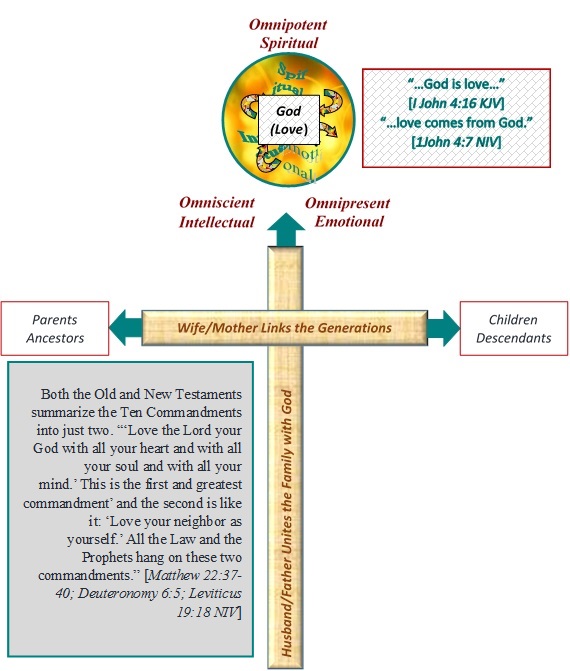
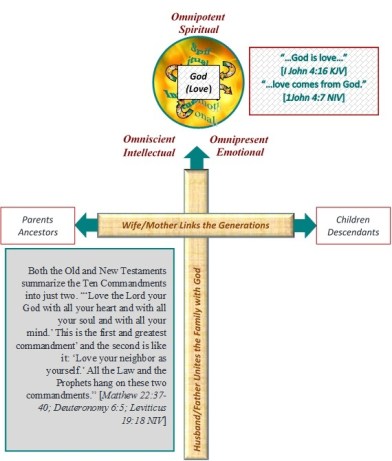
Both the Old and New Testaments summarize the Ten Commandments into just two. “‘Love the Lord your God with all your heart and with all your soul and with all your mind.’ This is the first and greatest commandment. And the second is like it: ‘Love your neighbor as yourself.’ All the Law and the Prophets hang on these two commandments.” [Matthew 22:37-40; Deuteronomy 6:5; Leviticus 19:18 NIV] Both commandments represent ultimate love characterized by extreme giving. The first is a vertical love of God; the second is a horizontal love of others.

Consider how those two commandments uniquely apply to marriage. Scripture explains the marriage relationship:

Submitting yourselves one to another in the fear (reverence, awe) of God. Wives, submit yourselves unto your own husbands, as unto the Lord. For the husband is the head of the wife, even as Christ is the head of the church: and he is the savior of the body. Therefore as the church is subject unto Christ, so let the wives be to their own husbands in everything. Husbands, love your wives, even as Christ also loved the church, and gave himself for it; that he might sanctify and cleanse it with the washing of water by the word, that he might present it to himself a glorious church, not having spot, or wrinkle, or any such thing; but that it should be holy and without blemish. [Ephesians 5:21-28 KJV (emphasis added)]

A husband must give himself for his family so they may become as perfect and blameless as is humanly possible. In essence, the husband and wife are mutual givers, but there is more, much more.

The earthly marriage is a representation of an eternal relationship with God. The Lord is illustrated scripturally as the bridegroom coming for his bride, the worldwide body of believers. “Let us rejoice and be glad and give him (Messiah) glory! For the wedding of the Lamb (Y’shua; Jesus) has come, and his bride has made herself ready…blessed are those who are invited to the wedding supper of the Lamb…These are the true words of God.” [Revelation 19:7&9 NIV] The Bible further clarifies that the apostle John, “saw the holy city, new Jerusalem, coming down from God out of heaven prepared as a bride adorned for her husband.” [Revelation 21:2 KJV]

Scripturally, the order of the universe is that the Lord is the bridegroom and the body of believers is the bride. Of course, in any earthly marriage the man is the bridegroom and the bride is the beautiful woman spectacularly dressed in a white wedding gown walking down the aisle to meet her man. But in a larger sense, the bride is not just the woman at the ceremony, the bride is the woman and by extension the children she later produces, often referred to as the fruit of her womb. The husband is required to love the wholeness of his bride, i.e. the wholeness of his family, even as the Messiah also loved the church, to the point of the husband’s own death if necessary.

Fallows magnificently explains, “The husband is the ‘house band,’ the earthly giver of life, uniting the divine with the human in the supreme function of fatherhood.” The wife is ‘the weaver,’ shaping and coloring in the prenatal and postnatal influences of sacred motherhood the destinies of her offspring.” “As the “earthly giver of life, uniting the divine with the human,” the husband/father becomes the role model for “the first and greatest commandment” to “Love the Lord your God with all your heart and with all your soul and with all your mind.”

As the “weaver,” the wife/mother is the connection between the past and future generations of her family, but also the past and future generations of the culture. She is the role model for the second summary commandment to ‘Love your neighbor as yourself.’ Shannon clarifies,

Mothers constitute the only universal agent of civilization. Nature has placed in her hands both infancy and youth. The vital interest of America hang largely upon the influence of mothers.” The queen that sits upon the throne of home, crowned and sceptered as none other ever can be, is—mother. Her enthronement is complete, her reign unrivaled, and the moral issues of her empire are eternal. “Her children rise up, and call her blessed.” Rebellious at times, as the subjects of her government may be, she rules them with marvelous patience, winning tenderness and undying love. She so presents and exemplifies divine truth, that it reproduces itself in the happiest development of childhood—character and life…An ounce of mother is worth more than a pound of clergy.

The complementary responsibilities of the husband/father and the wife/mother are awesome and readily illustrated by The Cross of Family Life, which of course resembles the iconic ancient cross used for crucifixion. Although the old Roman cross was a notorious instrument of extreme torture and ultimate sacrifice, for Christians it is also a symbol of incomparable love. The Lord’s amazing self-sacrifice was an expression of his infinite love for all mankind for all time. Similarly, The Cross of Family Life is a representation of the parents’ many daily sacrifices as an expression of their love. As an expression of God’s infinite love, Dad and Mom routinely set aside their own desires as an expression of love for each other, the children, and the larger culture.
Marriage Cross

Sadly, far too many dads in modern America fail to carry out their God-assigned, high- priority, family responsibilities, either due to a lack of holistic understanding, the powerful lure of excessive materialism or both. Far too many moms fall short by not being there and available for raising the children. Together, such parents effectively sacrifice their children on the altar of the false god of materialism. However, when Dad and Mom lovingly and enthusiastically bear The Cross of Family Life, the results can be deeply heartwarming and sometimes even breathtaking. When they do not, the results can range from troublesome to tragic.

Some time ago, I devoted seven years to meeting virtually all the needs and providing around-the-clock care for my terminally ill late wife. She endured a neurodegenerative condition similar to Alzheimer’s disease. After her passing, a well-wisher said. “You really sacrificed a lot during those years.” I thanked her and replied that it did not seem like I sacrificed anything. Providing total care was more important than anything else I could have been doing during that time. It was a monumentally life-changing experience that has had long-term impacts on me and those around me and will continue to do so far into the future.

Together, fueled by God’s infinite supply of love, Dad and Mom become virtual super heroes, an incredibly awesome team stabilizing God’s brilliantly designed family and the national culture as a whole. A child forms a vertical relationship with God, primarily, though not exclusively, through the role model of the father; a child forms horizontal relationships with others within and beyond the family primarily, though not exclusively, through the role model of the mother. The complementary combination produces godly character in the child. The actions of role modeling build character in the parents. The character of every family member extends outward to the community and the nation.

That is God’s grand design for Dad and Mom. What incredible superheroes!

Love the Lord your God with all your heart and with all your soul and with all your mind and with all your strength. [and] …love your neighbor as yourself.

Deuteronomy 6:5 & Leviticus 19:18/Matthew 22:37 & 39/Mark 12:30 & 31 NIV

All Love Comes from God

Significant spiritual growth occurs only to the extent that a Judeo-Christian believer routinely serves the physical, emotional, and spiritual needs of others thus growing in the character, by becoming increasingly humble, forgiving, merciful, longsuffering, and serving. That is God’s will for YOUR life.

As a child, did you ever play with a glass prism? It is a small wedge-shaped piece of glass with two triangular sides and three rectangular sides (one is the base). When sunlight or white light from any source is passed through the prism, the light is separated into its components revealing all the colors of the rainbow.

Scientists have demonstrated that all physical energy originates from the sun. Fossil fuels, for example, were once plants that absorbed solar energy through a process called photosynthesis. The plants used the energy from sunlight to combine water and carbon dioxide, producing glucose (a form of sugar) and oxygen. Large masses of dead plants exposed to elevated temperatures and pressures deep within the earth eventually became the crude oil and natural gas that are burned today to produce energy. Even the energy that supports our own life arises from the plants we eat or the animals we eat that have themselves fed on plants. Hence, we “burn calories” to release the energy that supports all body functions.

In contrast, love is spiritual energy. Just as the sun is the source of all physical energy, God is the source of all spiritual energy, because “…God is love…” [1 John 4:16 KJV] and “…love comes from God. [1 John 4:7 NIV] Similarly as light (physical/electromagnetic energy) is separated into its influences—a rainbow of colors—when the light passes through a glass prism, God’s love (spiritual energy) is separated into its influences when it passes through the prism of you and me.

All Love From God

The graphic shows how God’s infinite love is expressed through people. The components of love are expressed as attitudes and specific acts of humility, forgiveness, mercy, long-suffering, and a servant’s spirit. Collectively, the growth of those influences in each person’s life moves him/her toward the perfection of godly character, i.e. maturity. Multiple actions that spread God’s love in turn produce the fruit of that Spirit of giving, including love, joy, peace, patience, kindness, goodness, faithfulness, gentleness, and self-control.

Sadly, the prism of our life is not as clear as the glass prism we played with children. The prism of your life and mine is a bit fogged by the pride that becomes a barrier to the free flow of God’s love through us. That pride is our insistence on doing things our way instead of God’s way; it’s our personal war with God. It is pride that interferes with or obstructs efforts or even desire to be humble, forgiving, merciful, longsuffering, and having a servant’s spirit. Maturity is a lifelong process of overcoming pride. It is as if we hear God saying, “Get you pride out of the way and let My love pass through!” What do you think?

“Above all, love each other deeply, because love covers over a multitude of sins.” 1Peter 4:8 NIV “Hatred stirs up conflict, but love covers over all wrongs.” Proverbs 10:12 NIV

Happiness Arises from Good Health and Growing Interpersonal Relationships

The Declaration of Independence stipulates that, “We hold these truths to be self-evident, that all men are created equal, that they are endowed by their Creator with certain unalienable rights, that among these are life, liberty and the pursuit of happiness.” [emphasis added] Since these rights have been established and given by God, they are self-evident, requiring no further explanation or support. Such rights are unalienable, meaning that they cannot be abridged or infringed upon in any way by government. However, “we may do something ourselves to forfeit the unalienable rights endowed by the Creator, but no one else can TAKE those rights from us without being subject to God’s justice.” An example of forfeiture may be committing a crime that requires incarceration. Now that our right to the pursuit of happiness is locked in exactly what is it?

Diversity Ethnicity Multi-Ethnic Variation Togetherness Concept

Happiness is often equated with momentary or short-term excitement. “My favorite team won the Super Bowl!” “I got an ‘A’ in chemistry!” “She said ‘YES!’” There is no doubt about it; everyone enjoys that type of feel-good excitement. But it is based on emotion; it does not last. No one can live on a perpetual emotional high.

In contrast, a lifetime of long-term happiness has deeper spiritual roots that provide the support to withstand life’s challenges and hardships as well as celebrate the victories. That dimension of happiness reflects an inner joy anchored in a robust faith in God. Ever since Adam and Eve were evicted from the Garden of Eden for disobeying God, every life has experienced occasional or sometimes long-term suffering. But a robust faith provides a clear vision of the light at the end of the tunnel and an appreciation of the character building opportunities associated with the hardships. The inner joy may be severely challenged but remains secure despite the pain.

Although my late wife never suffered any real physical pain, she did endure the progressive loss of physical mobility and mental capacity. Did her suffering have a purpose? Absolutely! Her experience dramatically and permanently changed my life and has had a rapidly expanding rippling effect on everyone with whom I come in contact. I explained to a rather large crowd at her memorial service that she and God gave me one of the greatest gifts I have ever received—the wonderful and glorious gift of tears. As a man, an engineer trained in logic, and the product of a rather stoic family, there was not much room for a manly expression of tears. But the wonderful and glorious gift of tears stirred by seven years of accommodating her progressive loss opened up to me whole new realms of life experience both emotionally and spiritually that were not previously available. I became much more sensitive to the needs of disabled people and virtually everyone else as well. Her experience also contributed greatly to the motivation to write this book.

Happiness is the Result of Virtuous Living

Here’s the deal: Ultimately, happiness is the result of living a virtuous life. How boring is that? Actually, a virtuous life is not boring at all; it is very rich, satisfying, and happy. During George Washington’s First Inaugural Address, he emphasized, “…there is no truth more thoroughly established, than that there exists…an indissoluble union between virtue and happiness…” To President Washington, the link between “goodness and happiness” was plain and inescapable.” Further, Noah Webster found that, “If a republican government fails to secure public prosperity and happiness, it must be because the citizens neglect the divine commands, and elect bad man to make and administer the laws.” A life based on virtues anchored deeply in the soul produces goodness of choices and actions that ignite a happy and joyful spirit within an individual and ultimately across cultures.

Husbands, Would Your Wife Rather Be Home? Encourage Her!

The modern American culture has swerved so far away from the 7-millennium long traditional family-centered culture to the current career-centered culture that young women are virtually forced by cultural pressure to pursue a career as a higher priority than the family. Some have claimed it is possible to have it both ways. The reality is that more and more women are discovering that by definition there can only be one priority. If the priority is career, the family will suffer now and later.

Many women would genuinely prefer to be a homemaker. But those who are brave enough to face the wolfish cultural pressure may be confronted by another barrier closer to home. Today, many married men presumptively expect their wives to have a money-earning job outside the home.

Mother and grandchild baking cookies.

Traditionally—at least up until a few decades ago—men would be embarrassed if their wives worked outside the home. The men were proud of their ability to provide for the material needs and the security of their home. In just a few short decades, their pride succumbed to radical feminist pressures and transitioned to, “Honey, it’s OK to get a job if you want to; either way is OK with me.” The laisse-faire attitude, which was often interpreted by women as uncaring eventually became today’s, “Honey, you MUST have a job to help pay all of the bills.”

Severe cultural pressures and often poor financial planning create formidable barriers for the would-be homemaker. Here’s the rub! Men, if any of you are pressuring your wife to pursue a career, rather than encouraging her to be a homemaker, God has a very direct and stern warning for you. As you read the quote in three translations, remember, “The fear of the Lord is the beginning of wisdom:”

  • “The women of my people have ye cast out from their pleasant houses; from their children have ye taken away my glory forever. Arise ye, and depart; for this is not your rest: because it is polluted, it shall destroy you, even with a sore destruction.” [Micah 2:9-10 King James Version]
  • “You drive the women of my people from their pleasant homes. You take away my blessing from their children forever. Get up, go away! For this is not your resting place, because it is defiled, it is ruined, beyond all remedy.” [Micah 2:9-10 New International Version]
  • “You throw my people’s women out of the homes they love. You deprive their children of my glory forever. Get up and go! You can’t stay here! Because [the land] is now unclean, it will destroy you with a grievous destruction.” [Mikhah 2:9-10 Complete Jewish Bible]

The clarity of the three scripture translations is inescapable. Regardless of today’s cultural pressures, a husband must not encourage his wife to pursue a job outside the home. Whether or not she actually does is another discussion. However, first consider this:

God views the entirety of history as a continuum from Creation through the coming of the Messiah. He sees a holistic master portrait. That portrait includes a seamless parade of generations, each receiving the baton of civilization from the previous generation and passing it on to the next generation. At least that is His intent.

The woman as wife and mother is the link between generations. She learns from the previous generation, primarily from her mother, gives birth to the next generation, and is primarily responsible for nurturing and raising the next generation to become men and women of strong character, capable of carrying the baton of civilization onward to the following generation. She is ultimately responsible for the cohesiveness of the family and the sustainability of the culture.

The passage in Micah 2:9 indicates that when the homemaker is “cast out,” driven out, or thrown out of the home, to pursue material goals, the missing link forms a disconnect in the flow of generations and the preservation of civilization. The disconnect deprives the children of God’s glory for a very long time—the passage says, “forever.”

Visualize the disconnect as a seamless hand-knit sweater. When a single piece of yarn is broken, a slight tug causes the entire sweater to unravel. Similarly, the entire fabric of America unravels and is rapidly unraveling today when the family link in time is broken. Wow! That’s heavy; think about it for a few moments.

The greatest expression of love between a married man and woman is the birth of a child. New parents often cry out, “It’s a miracle from God!” and so it is. The child remains every bit as much a miracle at ages 2, 5, 10, 16 or beyond. The miracle child is on loan from God throughout the growing years. God has assigned the enormous responsibility to the parents, primarily the mother, to care for and raise His created miracle to become an adult of strong character who will continue to honor God and pass along an improved baton to the following generation. How could anything be a higher priority?

God places very high and challenging expectations on the woman. Her husband’s job is to make her job easy. One day, the parents causing or contributing to a disconnect at the expense of the children will be accountable to God. If that is you, what will you say, when God asks, “What did you do with my miracle?”

Happiness in the New Year Depends on Virtuous Living!

This time of year “Happy New Year” is everywhere. The greeting is repeated so often, it almost seems as if it is on autopilot. The New Year is celebrated with parties, prayers, parades, and football games. But how can we assure happiness in the New Year?

2015 Fireworks party - New Year Display!

Happiness is often equated with momentary or short-term excitement. “My favorite team won the Super Bowl!” “I got an ‘A’ in chemistry!” “She said ‘YES!’” There is no doubt about it; everyone enjoys that type of feel-good excitement. But it is based on emotion; it does not last. No one can live on a perpetually emotional high.

In contrast, a lifetime of long-term happiness has deeper spiritual roots that provide the support to withstand life’s challenges and hardships as well as celebrate the victories. That dimension of happiness reflects an inner joy anchored in a robust faith in God. Ever since Adam and Eve were evicted from the Garden of Eden for disobeying God, every life has experienced occasional or sometimes long-term suffering. But a robust faith provides a clear vision of the light at the end of the tunnel and an appreciation of the character building opportunities associated with the hardships. The inner joy may be severely challenged but remains secure despite the pain.

Although my late wife never suffered any real physical pain, she did endure the progressive loss of physical mobility and mental capacity. Did her suffering have a purpose? Absolutely! Her experience dramatically and permanently changed my life and has had a rapidly expanding rippling effect on everyone with whom I come in contact. I explained to a rather large crowd at her memorial service that she and God gave me one of the greatest gifts I have ever received—the wonderful and glorious gift of tears. As a man, an engineer trained in logic, and the product of a rather stoic family, where there was not much room for a manly expression of tears. But the wonderful and glorious gift of tears stirred by seven years of accommodating her progressive loss opened up to me whole new realms of life experience both emotionally and spiritually that were not previously available. I became much more sensitive to the needs of disabled people and virtually everyone else as well. Her experience also contributed greatly to the motivation to write a book.

Here’s the deal: Ultimately, happiness is the result of living a virtuous life. How boring is that? Actually, a virtuous life is not boring at all; it is very rich, satisfying, and happy. During George Washington’s First Inaugural Address, he emphasized, “…there is no truth more thoroughly established, than that there exists…an indissoluble union between virtue and happiness…” To President Washington, the link between “goodness and happiness” was plain and inescapable.” Further, Noah Webster found that, “If a republican government fails to secure public prosperity and happiness, it must be because the citizens neglect the divine commands, and elect bad man to make and administer the laws.” A life based on virtues anchored deeply in the soul produces goodness of choices and actions that ignite a happy and joyful spirit within an individual and ultimately across cultures.

Happy New Year to YOU!

Classic Movie: The Ten Commandments-Sephora Compares Biblical/Secular Values for Moses

After being banned from Egypt, Moses barely survives a devastating trek across the desert wilderness. He is rescued by a group of shepherd girls, daughters of Jethro, a Midianite priest. Just before their marriage, one of the girls, Sephora [Yvonne De Carlo] profoundly compares traditional and secular values for Moses [Charlton Heston]. Moses has just described an Egyptian woman looking “as beautiful as a jewel.”

shepherd

Sephora: “A jewel has brilliance, but gives no warmth.

  • Our hands are not so soft but they can serve.
  • Our bodies are not so white, but they are strong.
  • Our lips are not perfumed, but they speak the truth.
  • Love is not an art to us; it is life to us.
  • We are not dressed in gold and fine linen; strength and honor are our clothing.
  • Our tents are not the columned halls of Egypt, but our children play happily before them.
  • We can offer you little, but we offer all we have.”

Moses: “I have not little, Sephora; I have nothing.”

Sephora: “Nothing from some is more than gold from others.”

The conversation between Sephora (Greek form of Zipporah) and Moses just prior to their wedding is a clear contrast between:

  • traditional Biblical values, focusing on strong character and serving others (overcoming pride), and
  • secular values that recognize little significance in character and seeks to serve self (feeding pride and magnifying materialism).

Which would you marry? …the wealthy and materialistic, but shallow and self-centered Egyptian girl or the shepherd girl who understands the importance of virtue and strong character and is committed to a life of loving (serving) others.

  • Traditional Biblical values emerge from the wholeness of one’s soul as a conduit for God’s enduring love.
  • Evolution-rooted secular values, failing to recognize the reality of a spirit and limiting emotional considerations to Hedonistic highs/lows, emerge from primarily intellectual utilitarian considerations. The latter is a humanistic deification of man, based on the assumption that evolution has reached its highest current level in the human reasoning.

Which would you choose? “As for me and my house, we will serve the Lord.”

The Birth of the Light of the World

The Christmas season reminds us of some curious lyrics about love and light, in the most enduring Christmas carols. A closer look reveals that the curious lyrics are rooted in Scripture. Consider two examples:

  • Silent Night, Holy Night-3rd verse

Silent night, holy night Son of God, love’s pure light Radiant beams from Thy holy face With the dawn of redeeming grace Jesus, Lord, at Thy birth

  • Hark the Herald Angels Sing-3rd verse

Light and life to all He brings…”

There is a linkage between love and light and something very special about the linkage. Light has fascinated mankind since Creation; artists and scientists have had a complementary interest in studying light. But the highest source of information is Scripture. A look at what Scripture reveals about love and light may save artists and scientists considerable time and effort. We can do that right now:

  • “God is light; in him there is no darkness at all.” [1 John 1:5 NIV]—All electromagnetic energy that we perceive as light comes from the Sun. Since the light that illuminates the eyes was created by God, He is the physical light. God is also the spiritual light that illumines the soul.
  • “…God is love…” [1 John 4:16 KJV] and “…love comes from God.” [1 John 4:7 KJV]—Love is spiritual energy that comes from God, illuminates the soul, and fuels all interpersonal relationships. All love comes from God, whether the one loving gives God credit or not. Our greatest responsibility is to pass it on.

The Nativity scene.

The visible earthly expression of God’s love is in and through the Son (Jesus, Y’shua). He provided “…a light for revelation to the Gentiles and for glory to your people Israel.” [Luke 2:32 NIV] “In him was life, and that life was the light of men…The true light that gives light to every man was coming into the world.” [John 1:4 & 9 NIV]

After forgiving the adulteress, Jesus (Y’shua) confirmed “…’I am the light of the world. Whoever follows me will never walk in darkness. But will have the light of life.” [John 8:12 NIV]

Albert Einstein was famous for thought experiments. As a young man, he imagined riding a beam of light. Of course, Jesus could not ride a beam of light; he is the light. Instead, he chose to arrive in a stable through the humble darkness of a virgin’s womb. He was laid in an animal’s feeding trough called a manger. For 33 years, the “King of the Jews” lived a humble life serving others, ultimately exiting this life in the humblest way possible, dying virtually naked on the excruciatingly painful Roman cross.

King Jesus (Y’shua) came as a humble servant to model the life God intended for us to live and to pay the penalty for Adam’s first sin and all the sins in your life and mine. One day, the King will return as the conquering Messiah.

Don’t be afraid of any form of darkness; God is the light! Don’t fear any form of threat; God is love!

As for me, “The Lord is my light and my salvation…” [Psalm 27:1 NIV]

Won’t you join me?

Homemaker Enjoys The Most Important Career in the Universe!

A Homemaker enjoys the most influential and vital career in the universe. She is responsible for the stability of a culture and the cohesiveness of the family. She is the panoramic link in time, connecting the generations. She links the past to the future, ancestors to descendants. She is primarily responsible for raising the children in a manner that stabilizes their future and transmits critically important values to the next generation. In short, she makes the home the most desirable place in the universe for her family.

When the homemaker leaves the home, love leaves like air out of a flat tire. The home becomes the house, little more than the building where everyone comes to sleep at night.

ba3db6c0-032d-47ce-ad20-97352cf6f45d

Consider the fruit of a family-centered family as opposed to a career-centered family:

  • Builds strong cohesive families when Dad is responsible for standard-of-living and Mom is responsible for quality-of-life
  • Promotes a partnership between married men and women that grows closer with time
  • Children reared by those who love them most…Mom and Dad
  • Low risk monogamous sex provides for pleasure and reproduction
  • Number and frequency of venereal diseases sharply reduced and largely eliminated
  • Few abortions, because the unborn child is an expression of the parents’ love
  • One man; one woman; one lifetime is the stable marriage norm accepted for six millennia
  • Men and women both desire the stability of marriage
  • Stable relationships between a man and a woman due to the certainty of the marriage commitment
  • Infrequent divorce due to love and respect for spouse as well as responsibility for children
  • Legacy of cultural stability passed on to successive generations
  • Children experience and enjoy the complementary influences of a mom and a dad
  • “Alternative lifestyles” viewed as against nature, culturally destructive, and inappropriate especially when children are involved
  • Children are more stable, less stressed, more secure, and behavior is more predictable and…when necessary…more controllable
  • Husband and father is vital to the well-being of the family
  • Preserves and reinforces the sanctity of life and sanctity of marriage
  • Protects and reinforces the sovereignty of the family
  • Lifestyle evokes a happier and healthier woman and strong family relationships

What do you think? Have we lost something vitally important in our modern American culture?

God Modeled His Circle of Love for YOU!

Circle of Love

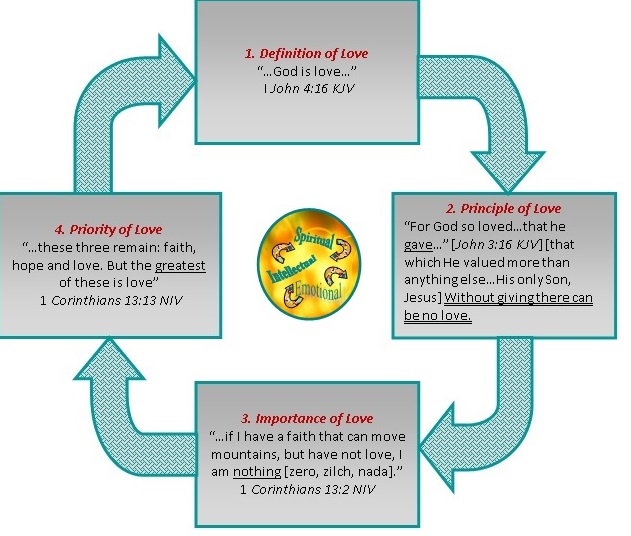
Very simply, “…God is love…” [1 John 4:16 KJV]. That’s it! Love is defined in just three little words, with no qualifiers. Now that does not sound very romantic does it? It certainly doesn’t sound very Hollywoodish. But there you have it in three simple words: God is love. The implications are profound. Love is the basis and driving force for ALL interpersonal relationships, including man-woman, parent-child, boss-employee, teacher-student, friend-friend, and neighbor-neighbor. The standout differences that distinctively set apart the marriage relationship include its intensity, depth, level of intimacy, and permanence. However, all relationships are built on love. Relationships grow to the extent that love grows; relationships weaken or terminate to the extent that love weakens. Love is so important to individuals, interpersonal relationships, and ultimately to cultures that a closer look is inescapable.

Consider Step 2 of the circle, the Principle of Love. Since all love originates from God, He is the best and only totally reliable source of wisdom regarding the practice of love. Although most people tend to focus on the back end of the best known and loved verse in the Bible, to understand the principle of love it is necessary to zoom in on the front end. “For God SO loved…that He GAVE…” [John 3:16 KJV] God loved us and all of His creation to such a great extent that He gave. What did He give? He gave that which He valued more than anything else “…His only begotten Son,” Jesus Christ who died on a brutal Roman cross to pay the penalty for the sins of all mankind. Since Scripture gives evidence that God is three persons in one, often called the Trinity, (God the Father, God the Son, and God the Holy Spirit) He effectively volunteered to give Himself as the ultimate expression of love.

Clearly, without giving there can be no love. Love and all relationships grow to the extent that there is regular giving. Love and relationships weaken or terminate when giving slows or stops. The marriage relationship has one distinct difference. It is intended and decreed by God to be permanent regardless of internal circumstances. It can be a loving marriage or a loveless marriage as the husband and wife choose, but either way it is permanent. “Therefore, what God has joined together, let man not separate.” [Mark. 10:9 NIV] Look for much more about the marriage concept in upcoming blogs. Love is always dynamic; it is never static. It cannot stand still; it will either grow or weaken as time passes.

Since God is love, what does He have to say about the importance of love? 1 Corinthians 13:2 [NIV] clearly underscores the Importance of Love in my life and yours. “…if I have a faith that can move mountains, but have not love, I am NOTHING.” (zero, zilch, nada) I learned long ago that zero is a very small number. The brightness of God is shining inescapably on the view that if my life and yours are not clearly characterized by love, as evidenced by continuous giving, we are wasting the awesome and precious gift of life that God has given us.

Since love is critically important to a rich life experience, it should be no surprise that God gives it the highest of all priorities. Step 4 of God’s Circle of Love cites 1 Corinthians 13:13 [NIV], “…these three remain: faith, hope and love. But the greatest of these is love.” Whoa! How can love be the greatest? Does not faith “unlock the door” to heaven, our preferred eternal destiny? Isn’t eternity more important than the fleeting temporary life here and now? Of course it is! However, Scripture says that love is greater than faith or hope simply because “God is love,” thus closing God’s Circle of Love. Love drives all relationships. As a practical matter, a love-driven life reduces stress thus enriching all of life’s experiences.

Have You Ever Received a Love Letter from God?

Roses bouquet and greeting card

God’s love letter—the Bible—contains everything necessary to assure the richest possible human experience. However, simple intellectual knowledge of the Bible is seldom sufficient to change a life to the extent necessary to experience the full richness of life that God intended. A life-changing experience tends to arise when intellectual knowledge expands to include emotional and spiritual knowledge deeply embedded within the soul. The movement of the wholeness of knowledge from the head to the soul arises from growing interpersonal relationships and frequent, active, and conscious choices to serve the needs of others, sacrificing the desires of self along the way. Knowledge embedded in the soul creates the drive to do right and grow in godly character. Soulful knowledge evokes motivation; head knowledge is merely stored.

However, godly growth—the movement of the fragmented head knowledge to the wholeness of the soul—is inhibited by intense cultural peer pressure. Like everyone else, Jews and Christians are endlessly bombarded by the lures of materialism, self-indulgence, and boundaryless sex, which virtually always come at the expense of others. The lures are so intense and unrelenting that they facilitate compromises in honesty, integrity, and other important character values. The lack of values has become a new norm in the mainstream culture and a persistent temptation within what remains of the Judeo-Christian culture. So many believers have at least tacitly moved from a sense of temptation to the new norm of lost or compromised values that statistically there is no difference in the tragic rates of divorce and abortion between believers and unbelievers, including atheists and agnostics.

No one wakes up in the morning stretching, rubbing the sleep out of his or her eyes thinking, “What a beautiful day; what a great day to go out and sin!” Compromises to values, patterns of poor behavior, and a drift away from God progressively result from extremely small, barely inappropriate, seemingly inconsequential decisions that accumulate over days, weeks, months, and years. The gradual erosion of values is ultimately passed from generation to generation. The end game is that the American culture and the great American experiment in self-rule are in grave jeopardy, because Judeo-Christian believers have become compromised followers, rather than principled leaders. The cultural pressures are so great that believers are unlikely to mature and grow in character without making regular, conscious, deliberate decisions to serve the needs of others, beginning with the family and working outwards. In an expanded sense, the price of spiritual apathy is extremely high here and may cause many people to miss out on eternity with God later.

The Judeo-Christian culture is a subset of the national culture. From the founding of the United States through the first 150 years, the Christian culture and Judeo-Christian tradition dominated the national culture. Regardless of whether or not specific individuals or groups were “believers,” the culture was driven by the national “soul,” which was steeped in Judeo-Christian tradition. But in recent decades major demographic changes along with the steady erosion of morals and traditional standards of behavior have resulted in a shrinking proportion of loving devout believers in the American culture wielding diminishing influence. The United States simply cannot survive continued massive assaults on Christianity, the family, the Constitution, and the free enterprise economic system. Founder John Adams thoughtfully commented:

We have no government armed with power capable of contending with human passions unbridled by morality and religion. Avarice, ambition, revenge, or gallantry, would break the strongest cords of our Constitution as a whale goes through a net. Our Constitution was made only for a moral and religious people. It is wholly inadequate to the government of any other.

Several years ago a protestant pastor was heard commenting that, “Christians no longer have a culture.” They have been largely assimilated by the secularized national culture. Similarly, in an interview, the Catholic Pope Benedict was asked to identify the greatest challenge facing the church today. His reply was that the greatest challenge facing the church today is the secularization of the church, a response remarkably similar to the pastor’s comment. What do you think?

What is Love?

sunset in heart hands

Ask a number of people, “What is love?” Most will be unable to define “love,” even though nearly everyone uses the word virtually every day and often many times a day. Some people will respond with a blank stare, some with a quip (It’s like pornography; I know it when I see it.) Occasionally someone may say that, “The Bible tells you all about love in I Corinthians 13.” True, that passage does list the characteristics of love but, does not define it. Rarely does anyone get it right.

If you talk to any Christian for a few minutes on the subject of love, he/she will go on autopilot and somewhat mechanically refer you to 1 Corinthians 13. Since all Scripture is inspired, it’s great stuff. However, it is a post-graduate course in love that is seldom understood in a soul-deep, urgent, action-oriented sense, despite the thousands of sermons devoted to it. Just as some university courses have certain prerequisites, God’s graduate course in love also has prerequisites.

Very simply, “…God is love…” [1 John 4:16 KJV]. That’s it! Love is defined in just three little words, with no qualifiers. Now that does not sound very romantic does it? It certainly doesn’t sound very Hollywoodish. But there you have it in three simple words: God is love. The implications are profound. Love is the basis and driving force for ALL interpersonal relationships, including man-woman, parent-child, boss-employee, teacher-student, friend-friend, and neighbor-neighbor. The standout differences that distinctively set apart the marriage relationship include its intensity, depth, level of intimacy, and permanence. However, all relationships are built on love. Relationships grow to the extent that love grows; relationships weaken or terminate to the extent that love weakens. Love is so important to individuals, interpersonal relationships, and ultimately to cultures that a closer look is inescapable. What do you think?