Husbands, Would Your Wife Rather Be Home? Encourage Her!

The modern American culture has swerved so far away from the 7-millennium long traditional family-centered culture to the current career-centered culture that young women are virtually forced by cultural pressure to pursue a career as a higher priority than the family. Some have claimed it is possible to have it both ways. The reality is that more and more women are discovering that by definition there can only be one priority. If the priority is career, the family will suffer now and later.

Many women would genuinely prefer to be a homemaker. But those who are brave enough to face the wolfish cultural pressure may be confronted by another barrier closer to home. Today, many married men presumptively expect their wives to have a money-earning job outside the home.

Mother and grandchild baking cookies.

Traditionally—at least up until a few decades ago—men would be embarrassed if their wives worked outside the home. The men were proud of their ability to provide for the material needs and the security of their home. In just a few short decades, their pride succumbed to radical feminist pressures and transitioned to, “Honey, it’s OK to get a job if you want to; either way is OK with me.” The laisse-faire attitude, which was often interpreted by women as uncaring eventually became today’s, “Honey, you MUST have a job to help pay all of the bills.”

Severe cultural pressures and often poor financial planning create formidable barriers for the would-be homemaker. Here’s the rub! Men, if any of you are pressuring your wife to pursue a career, rather than encouraging her to be a homemaker, God has a very direct and stern warning for you. As you read the quote in three translations, remember, “The fear of the Lord is the beginning of wisdom:”

  • “The women of my people have ye cast out from their pleasant houses; from their children have ye taken away my glory forever. Arise ye, and depart; for this is not your rest: because it is polluted, it shall destroy you, even with a sore destruction.” [Micah 2:9-10 King James Version]
  • “You drive the women of my people from their pleasant homes. You take away my blessing from their children forever. Get up, go away! For this is not your resting place, because it is defiled, it is ruined, beyond all remedy.” [Micah 2:9-10 New International Version]
  • “You throw my people’s women out of the homes they love. You deprive their children of my glory forever. Get up and go! You can’t stay here! Because [the land] is now unclean, it will destroy you with a grievous destruction.” [Mikhah 2:9-10 Complete Jewish Bible]

The clarity of the three scripture translations is inescapable. Regardless of today’s cultural pressures, a husband must not encourage his wife to pursue a job outside the home. Whether or not she actually does is another discussion. However, first consider this:

God views the entirety of history as a continuum from Creation through the coming of the Messiah. He sees a holistic master portrait. That portrait includes a seamless parade of generations, each receiving the baton of civilization from the previous generation and passing it on to the next generation. At least that is His intent.

The woman as wife and mother is the link between generations. She learns from the previous generation, primarily from her mother, gives birth to the next generation, and is primarily responsible for nurturing and raising the next generation to become men and women of strong character, capable of carrying the baton of civilization onward to the following generation. She is ultimately responsible for the cohesiveness of the family and the sustainability of the culture.

The passage in Micah 2:9 indicates that when the homemaker is “cast out,” driven out, or thrown out of the home, to pursue material goals, the missing link forms a disconnect in the flow of generations and the preservation of civilization. The disconnect deprives the children of God’s glory for a very long time—the passage says, “forever.”

Visualize the disconnect as a seamless hand-knit sweater. When a single piece of yarn is broken, a slight tug causes the entire sweater to unravel. Similarly, the entire fabric of America unravels and is rapidly unraveling today when the family link in time is broken. Wow! That’s heavy; think about it for a few moments.

The greatest expression of love between a married man and woman is the birth of a child. New parents often cry out, “It’s a miracle from God!” and so it is. The child remains every bit as much a miracle at ages 2, 5, 10, 16 or beyond. The miracle child is on loan from God throughout the growing years. God has assigned the enormous responsibility to the parents, primarily the mother, to care for and raise His created miracle to become an adult of strong character who will continue to honor God and pass along an improved baton to the following generation. How could anything be a higher priority?

God places very high and challenging expectations on the woman. Her husband’s job is to make her job easy. One day, the parents causing or contributing to a disconnect at the expense of the children will be accountable to God. If that is you, what will you say, when God asks, “What did you do with my miracle?”


Classic Movie: The Ten Commandments-Sephora Compares Biblical/Secular Values for Moses

After being banned from Egypt, Moses barely survives a devastating trek across the desert wilderness. He is rescued by a group of shepherd girls, daughters of Jethro, a Midianite priest. Just before their marriage, one of the girls, Sephora [Yvonne De Carlo] profoundly compares traditional and secular values for Moses [Charlton Heston]. Moses has just described an Egyptian woman looking “as beautiful as a jewel.”

shepherd

Sephora: “A jewel has brilliance, but gives no warmth.

  • Our hands are not so soft but they can serve.
  • Our bodies are not so white, but they are strong.
  • Our lips are not perfumed, but they speak the truth.
  • Love is not an art to us; it is life to us.
  • We are not dressed in gold and fine linen; strength and honor are our clothing.
  • Our tents are not the columned halls of Egypt, but our children play happily before them.
  • We can offer you little, but we offer all we have.”

Moses: “I have not little, Sephora; I have nothing.”

Sephora: “Nothing from some is more than gold from others.”

The conversation between Sephora (Greek form of Zipporah) and Moses just prior to their wedding is a clear contrast between:

  • traditional Biblical values, focusing on strong character and serving others (overcoming pride), and
  • secular values that recognize little significance in character and seeks to serve self (feeding pride and magnifying materialism).

Which would you marry? …the wealthy and materialistic, but shallow and self-centered Egyptian girl or the shepherd girl who understands the importance of virtue and strong character and is committed to a life of loving (serving) others.

  • Traditional Biblical values emerge from the wholeness of one’s soul as a conduit for God’s enduring love.
  • Evolution-rooted secular values, failing to recognize the reality of a spirit and limiting emotional considerations to Hedonistic highs/lows, emerge from primarily intellectual utilitarian considerations. The latter is a humanistic deification of man, based on the assumption that evolution has reached its highest current level in the human reasoning.

Which would you choose? “As for me and my house, we will serve the Lord.”

What Do Jews Think About Christmas Celebrations?

Nearly all Americans (93%) celebrate Christmas. Only an extremely tiny minority would object to the greeting, “Merry Christmas,” a cherry greeting roughly equivalent to, “I love you,” Yet, political correctness, championed by the liberal/progressive movement, has effectively eliminated the Merry Christmas greeting from public life as well as nativity scenes and other symbols of Christmas.

God's Love

In contrast, consider what three nationally-known Jewish leaders have to say about Christmas celebrations:

Burt Prelutsky, a Jewish columnist for a number of national publications, declares:

I never thought I’d live to see the day that Christmas would become a dirty word. . . . How is it, one well might ask, that in a Christian nation this is happening? . . . Speaking as a member of a minority group – and one of the smaller ones at that – I say it behooves those of us who don’t accept Jesus Christ as our savior to show some gratitude to those who do, and to start respecting the values and traditions of the overwhelming majority of our fellow citizens, just as we keep insisting that they respect ours. Merry Christmas, my friends!

Orthodox Jewish Rabbi Daniel Lapin agrees:

Secular fundamentalism has successfully injected into American culture the notion that the word “Christmas” is deeply offensive. . . . Anti-Christianism is unhealthy for all Americans; but I warn my brethren that it will prove particularly destructive for Jews. . . . Let us all go out of our way to wish our many wonderful Christian friends – a very merry Christmas. Just remember, America’s Bible belt is our safety belt.

Orthodox Jewish radio host and creator of PragerUniversity.com Dennis Prager writes:

As a Jew, and a religious one at that, I want to wish my fellow Americans a Merry Christmas. Not “Happy Holidays.” Merry Christmas…

It doesn’t matter with which religion or ethnic group you identify; Christmas in America is as American as the proverbial apple pie. That is why some of the most famous and beloved Christmas songs were written by guess who? Jews.

  • White Christmas—Irving Berlin
  • Rudolph, the Red-Nosed Reindeer—Johnny Marks
  • Let It Snow! Let It snow! Let It Snow!—July Styne/Sammy Cahn
  • Silver Bells—Jay Livingston/Ray Evans
  • The Christmas Song (Chestnuts roasting on an Open Fire—Mel Torme/Robert Wells
  • Sleigh ride-–Mitchell Parish

and many others.

The notion that non-Christians are excluded is absurd.

It never occurred to my Orthodox Jewish family not to enjoy this season. It was a tradition in our home to watch the Christmas Mass from the Vatican every Christmas Eve…Had you visited our home, you would have seen my mother—and my father, my brother and I all wearing our kippot (Jewish skull-caps)—watching Catholics celebrate Christmas…

So when and why did this pernicious nonsense of non-Christians being “excluded” by public celebration of Christmas develop?

It is nothing more than another destructive product of the 1960s and 1970s, when the left came to dominate much of the culture.

There you have it! Say “Merry Christmas” everywhere; say it again and again and again. Say Merry Christmas with love every time. Saying it mechanically, without love betrays the greeting and the Lord.

Family at Christmas dinner

So—Spread the Deliberate Joy; spread the merriment. After all, love is contagious. And—don’t forget the reason for the season!

Blogging YOU the warmest and merriest Christmas ever!

The first two quotes were abstracted from http://www.wallbuilders.com. The third quote is from wnd.com magazine, Whistleblower, “Of Messiahs False and True,” December 2014.

Homemaker Enjoys The Most Important Career in the Universe!

A Homemaker enjoys the most influential and vital career in the universe. She is responsible for the stability of a culture and the cohesiveness of the family. She is the panoramic link in time, connecting the generations. She links the past to the future, ancestors to descendants. She is primarily responsible for raising the children in a manner that stabilizes their future and transmits critically important values to the next generation. In short, she makes the home the most desirable place in the universe for her family.

When the homemaker leaves the home, love leaves like air out of a flat tire. The home becomes the house, little more than the building where everyone comes to sleep at night.

ba3db6c0-032d-47ce-ad20-97352cf6f45d

Consider the fruit of a family-centered family as opposed to a career-centered family:

  • Builds strong cohesive families when Dad is responsible for standard-of-living and Mom is responsible for quality-of-life
  • Promotes a partnership between married men and women that grows closer with time
  • Children reared by those who love them most…Mom and Dad
  • Low risk monogamous sex provides for pleasure and reproduction
  • Number and frequency of venereal diseases sharply reduced and largely eliminated
  • Few abortions, because the unborn child is an expression of the parents’ love
  • One man; one woman; one lifetime is the stable marriage norm accepted for six millennia
  • Men and women both desire the stability of marriage
  • Stable relationships between a man and a woman due to the certainty of the marriage commitment
  • Infrequent divorce due to love and respect for spouse as well as responsibility for children
  • Legacy of cultural stability passed on to successive generations
  • Children experience and enjoy the complementary influences of a mom and a dad
  • “Alternative lifestyles” viewed as against nature, culturally destructive, and inappropriate especially when children are involved
  • Children are more stable, less stressed, more secure, and behavior is more predictable and…when necessary…more controllable
  • Husband and father is vital to the well-being of the family
  • Preserves and reinforces the sanctity of life and sanctity of marriage
  • Protects and reinforces the sovereignty of the family
  • Lifestyle evokes a happier and healthier woman and strong family relationships

What do you think? Have we lost something vitally important in our modern American culture?

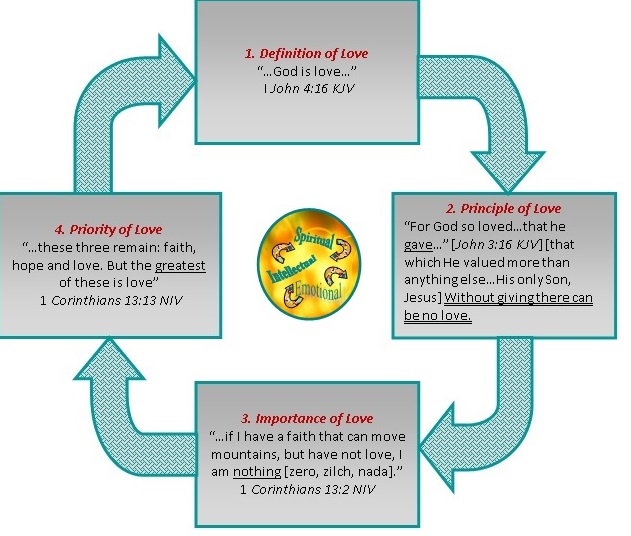
God Modeled His Circle of Love for YOU!

Circle of Love

Very simply, “…God is love…” [1 John 4:16 KJV]. That’s it! Love is defined in just three little words, with no qualifiers. Now that does not sound very romantic does it? It certainly doesn’t sound very Hollywoodish. But there you have it in three simple words: God is love. The implications are profound. Love is the basis and driving force for ALL interpersonal relationships, including man-woman, parent-child, boss-employee, teacher-student, friend-friend, and neighbor-neighbor. The standout differences that distinctively set apart the marriage relationship include its intensity, depth, level of intimacy, and permanence. However, all relationships are built on love. Relationships grow to the extent that love grows; relationships weaken or terminate to the extent that love weakens. Love is so important to individuals, interpersonal relationships, and ultimately to cultures that a closer look is inescapable.

Consider Step 2 of the circle, the Principle of Love. Since all love originates from God, He is the best and only totally reliable source of wisdom regarding the practice of love. Although most people tend to focus on the back end of the best known and loved verse in the Bible, to understand the principle of love it is necessary to zoom in on the front end. “For God SO loved…that He GAVE…” [John 3:16 KJV] God loved us and all of His creation to such a great extent that He gave. What did He give? He gave that which He valued more than anything else “…His only begotten Son,” Jesus Christ who died on a brutal Roman cross to pay the penalty for the sins of all mankind. Since Scripture gives evidence that God is three persons in one, often called the Trinity, (God the Father, God the Son, and God the Holy Spirit) He effectively volunteered to give Himself as the ultimate expression of love.

Clearly, without giving there can be no love. Love and all relationships grow to the extent that there is regular giving. Love and relationships weaken or terminate when giving slows or stops. The marriage relationship has one distinct difference. It is intended and decreed by God to be permanent regardless of internal circumstances. It can be a loving marriage or a loveless marriage as the husband and wife choose, but either way it is permanent. “Therefore, what God has joined together, let man not separate.” [Mark. 10:9 NIV] Look for much more about the marriage concept in upcoming blogs. Love is always dynamic; it is never static. It cannot stand still; it will either grow or weaken as time passes.

Since God is love, what does He have to say about the importance of love? 1 Corinthians 13:2 [NIV] clearly underscores the Importance of Love in my life and yours. “…if I have a faith that can move mountains, but have not love, I am NOTHING.” (zero, zilch, nada) I learned long ago that zero is a very small number. The brightness of God is shining inescapably on the view that if my life and yours are not clearly characterized by love, as evidenced by continuous giving, we are wasting the awesome and precious gift of life that God has given us.

Since love is critically important to a rich life experience, it should be no surprise that God gives it the highest of all priorities. Step 4 of God’s Circle of Love cites 1 Corinthians 13:13 [NIV], “…these three remain: faith, hope and love. But the greatest of these is love.” Whoa! How can love be the greatest? Does not faith “unlock the door” to heaven, our preferred eternal destiny? Isn’t eternity more important than the fleeting temporary life here and now? Of course it is! However, Scripture says that love is greater than faith or hope simply because “God is love,” thus closing God’s Circle of Love. Love drives all relationships. As a practical matter, a love-driven life reduces stress thus enriching all of life’s experiences.

Have You Ever Received a Love Letter from God?

Roses bouquet and greeting card

God’s love letter—the Bible—contains everything necessary to assure the richest possible human experience. However, simple intellectual knowledge of the Bible is seldom sufficient to change a life to the extent necessary to experience the full richness of life that God intended. A life-changing experience tends to arise when intellectual knowledge expands to include emotional and spiritual knowledge deeply embedded within the soul. The movement of the wholeness of knowledge from the head to the soul arises from growing interpersonal relationships and frequent, active, and conscious choices to serve the needs of others, sacrificing the desires of self along the way. Knowledge embedded in the soul creates the drive to do right and grow in godly character. Soulful knowledge evokes motivation; head knowledge is merely stored.

However, godly growth—the movement of the fragmented head knowledge to the wholeness of the soul—is inhibited by intense cultural peer pressure. Like everyone else, Jews and Christians are endlessly bombarded by the lures of materialism, self-indulgence, and boundaryless sex, which virtually always come at the expense of others. The lures are so intense and unrelenting that they facilitate compromises in honesty, integrity, and other important character values. The lack of values has become a new norm in the mainstream culture and a persistent temptation within what remains of the Judeo-Christian culture. So many believers have at least tacitly moved from a sense of temptation to the new norm of lost or compromised values that statistically there is no difference in the tragic rates of divorce and abortion between believers and unbelievers, including atheists and agnostics.

No one wakes up in the morning stretching, rubbing the sleep out of his or her eyes thinking, “What a beautiful day; what a great day to go out and sin!” Compromises to values, patterns of poor behavior, and a drift away from God progressively result from extremely small, barely inappropriate, seemingly inconsequential decisions that accumulate over days, weeks, months, and years. The gradual erosion of values is ultimately passed from generation to generation. The end game is that the American culture and the great American experiment in self-rule are in grave jeopardy, because Judeo-Christian believers have become compromised followers, rather than principled leaders. The cultural pressures are so great that believers are unlikely to mature and grow in character without making regular, conscious, deliberate decisions to serve the needs of others, beginning with the family and working outwards. In an expanded sense, the price of spiritual apathy is extremely high here and may cause many people to miss out on eternity with God later.

The Judeo-Christian culture is a subset of the national culture. From the founding of the United States through the first 150 years, the Christian culture and Judeo-Christian tradition dominated the national culture. Regardless of whether or not specific individuals or groups were “believers,” the culture was driven by the national “soul,” which was steeped in Judeo-Christian tradition. But in recent decades major demographic changes along with the steady erosion of morals and traditional standards of behavior have resulted in a shrinking proportion of loving devout believers in the American culture wielding diminishing influence. The United States simply cannot survive continued massive assaults on Christianity, the family, the Constitution, and the free enterprise economic system. Founder John Adams thoughtfully commented:

We have no government armed with power capable of contending with human passions unbridled by morality and religion. Avarice, ambition, revenge, or gallantry, would break the strongest cords of our Constitution as a whale goes through a net. Our Constitution was made only for a moral and religious people. It is wholly inadequate to the government of any other.

Several years ago a protestant pastor was heard commenting that, “Christians no longer have a culture.” They have been largely assimilated by the secularized national culture. Similarly, in an interview, the Catholic Pope Benedict was asked to identify the greatest challenge facing the church today. His reply was that the greatest challenge facing the church today is the secularization of the church, a response remarkably similar to the pastor’s comment. What do you think?

What is Love?

sunset in heart hands

Ask a number of people, “What is love?” Most will be unable to define “love,” even though nearly everyone uses the word virtually every day and often many times a day. Some people will respond with a blank stare, some with a quip (It’s like pornography; I know it when I see it.) Occasionally someone may say that, “The Bible tells you all about love in I Corinthians 13.” True, that passage does list the characteristics of love but, does not define it. Rarely does anyone get it right.

If you talk to any Christian for a few minutes on the subject of love, he/she will go on autopilot and somewhat mechanically refer you to 1 Corinthians 13. Since all Scripture is inspired, it’s great stuff. However, it is a post-graduate course in love that is seldom understood in a soul-deep, urgent, action-oriented sense, despite the thousands of sermons devoted to it. Just as some university courses have certain prerequisites, God’s graduate course in love also has prerequisites.

Very simply, “…God is love…” [1 John 4:16 KJV]. That’s it! Love is defined in just three little words, with no qualifiers. Now that does not sound very romantic does it? It certainly doesn’t sound very Hollywoodish. But there you have it in three simple words: God is love. The implications are profound. Love is the basis and driving force for ALL interpersonal relationships, including man-woman, parent-child, boss-employee, teacher-student, friend-friend, and neighbor-neighbor. The standout differences that distinctively set apart the marriage relationship include its intensity, depth, level of intimacy, and permanence. However, all relationships are built on love. Relationships grow to the extent that love grows; relationships weaken or terminate to the extent that love weakens. Love is so important to individuals, interpersonal relationships, and ultimately to cultures that a closer look is inescapable. What do you think?


No Homemaker “Gap” in Resume

beautiful smiling girl with headscarf

Occasionally, women who have stayed at home for a number of years to be a homemaker and mother ask me how to handle the “gap” in their resume. I tell them that there is no gap. They have served as the:

Chief Operations Officer (COO) of the home, responsible for:

  1. operations and maintenance of the home,
  2. capital improvements (remodeling),
  3. purchasing, budgeting, financial management, and marketing (representing the family’s interests and reputation inside and outside the home),
  4. managing subcontractors (plumbers, electricians, appliance repairs, yard workers, etc.),
  5. field operations (activities related to hobbies, sports, and places of worship),
  6. human resource management (inspiring and motivating family members to be productive and actively responsible),
  7. personnel training (raising the children with a strong sense of values), and
  8. environmental management (greening the home & family worldview).

Building a safe, stress free family organizational culture. Making the home the most desirable place in the universe for the family and raising offspring to become adults of strong character is a boundaryless (24/7) full time responsibility. Serving as a homemaker is much like running a small business. The multidisciplinary wisdom and management experience acquired is applicable to virtually any workplace.

If you agree with the above characterization of a homemaker, you may feel free to use it without attribution. What do you think?