Happiness in the New Year Depends on Virtuous Living!

This time of year “Happy New Year” is everywhere. The greeting is repeated so often, it almost seems as if it is on autopilot. The New Year is celebrated with parties, prayers, parades, and football games. But how can we assure happiness in the New Year?

2015 Fireworks party - New Year Display!

Happiness is often equated with momentary or short-term excitement. “My favorite team won the Super Bowl!” “I got an ‘A’ in chemistry!” “She said ‘YES!’” There is no doubt about it; everyone enjoys that type of feel-good excitement. But it is based on emotion; it does not last. No one can live on a perpetually emotional high.

In contrast, a lifetime of long-term happiness has deeper spiritual roots that provide the support to withstand life’s challenges and hardships as well as celebrate the victories. That dimension of happiness reflects an inner joy anchored in a robust faith in God. Ever since Adam and Eve were evicted from the Garden of Eden for disobeying God, every life has experienced occasional or sometimes long-term suffering. But a robust faith provides a clear vision of the light at the end of the tunnel and an appreciation of the character building opportunities associated with the hardships. The inner joy may be severely challenged but remains secure despite the pain.

Although my late wife never suffered any real physical pain, she did endure the progressive loss of physical mobility and mental capacity. Did her suffering have a purpose? Absolutely! Her experience dramatically and permanently changed my life and has had a rapidly expanding rippling effect on everyone with whom I come in contact. I explained to a rather large crowd at her memorial service that she and God gave me one of the greatest gifts I have ever received—the wonderful and glorious gift of tears. As a man, an engineer trained in logic, and the product of a rather stoic family, where there was not much room for a manly expression of tears. But the wonderful and glorious gift of tears stirred by seven years of accommodating her progressive loss opened up to me whole new realms of life experience both emotionally and spiritually that were not previously available. I became much more sensitive to the needs of disabled people and virtually everyone else as well. Her experience also contributed greatly to the motivation to write a book.

Here’s the deal: Ultimately, happiness is the result of living a virtuous life. How boring is that? Actually, a virtuous life is not boring at all; it is very rich, satisfying, and happy. During George Washington’s First Inaugural Address, he emphasized, “…there is no truth more thoroughly established, than that there exists…an indissoluble union between virtue and happiness…” To President Washington, the link between “goodness and happiness” was plain and inescapable.” Further, Noah Webster found that, “If a republican government fails to secure public prosperity and happiness, it must be because the citizens neglect the divine commands, and elect bad man to make and administer the laws.” A life based on virtues anchored deeply in the soul produces goodness of choices and actions that ignite a happy and joyful spirit within an individual and ultimately across cultures.

Happy New Year to YOU!

The Birth of the Light of the World

The Christmas season reminds us of some curious lyrics about love and light, in the most enduring Christmas carols. A closer look reveals that the curious lyrics are rooted in Scripture. Consider two examples:

  • Silent Night, Holy Night-3rd verse

Silent night, holy night Son of God, love’s pure light Radiant beams from Thy holy face With the dawn of redeeming grace Jesus, Lord, at Thy birth

  • Hark the Herald Angels Sing-3rd verse

Light and life to all He brings…”

There is a linkage between love and light and something very special about the linkage. Light has fascinated mankind since Creation; artists and scientists have had a complementary interest in studying light. But the highest source of information is Scripture. A look at what Scripture reveals about love and light may save artists and scientists considerable time and effort. We can do that right now:

  • “God is light; in him there is no darkness at all.” [1 John 1:5 NIV]—All electromagnetic energy that we perceive as light comes from the Sun. Since the light that illuminates the eyes was created by God, He is the physical light. God is also the spiritual light that illumines the soul.
  • “…God is love…” [1 John 4:16 KJV] and “…love comes from God.” [1 John 4:7 KJV]—Love is spiritual energy that comes from God, illuminates the soul, and fuels all interpersonal relationships. All love comes from God, whether the one loving gives God credit or not. Our greatest responsibility is to pass it on.

The Nativity scene.

The visible earthly expression of God’s love is in and through the Son (Jesus, Y’shua). He provided “…a light for revelation to the Gentiles and for glory to your people Israel.” [Luke 2:32 NIV] “In him was life, and that life was the light of men…The true light that gives light to every man was coming into the world.” [John 1:4 & 9 NIV]

After forgiving the adulteress, Jesus (Y’shua) confirmed “…’I am the light of the world. Whoever follows me will never walk in darkness. But will have the light of life.” [John 8:12 NIV]

Albert Einstein was famous for thought experiments. As a young man, he imagined riding a beam of light. Of course, Jesus could not ride a beam of light; he is the light. Instead, he chose to arrive in a stable through the humble darkness of a virgin’s womb. He was laid in an animal’s feeding trough called a manger. For 33 years, the “King of the Jews” lived a humble life serving others, ultimately exiting this life in the humblest way possible, dying virtually naked on the excruciatingly painful Roman cross.

King Jesus (Y’shua) came as a humble servant to model the life God intended for us to live and to pay the penalty for Adam’s first sin and all the sins in your life and mine. One day, the King will return as the conquering Messiah.

Don’t be afraid of any form of darkness; God is the light! Don’t fear any form of threat; God is love!

As for me, “The Lord is my light and my salvation…” [Psalm 27:1 NIV]

Won’t you join me?

What Do Jews Think About Christmas Celebrations?

Nearly all Americans (93%) celebrate Christmas. Only an extremely tiny minority would object to the greeting, “Merry Christmas,” a cherry greeting roughly equivalent to, “I love you,” Yet, political correctness, championed by the liberal/progressive movement, has effectively eliminated the Merry Christmas greeting from public life as well as nativity scenes and other symbols of Christmas.

God's Love

In contrast, consider what three nationally-known Jewish leaders have to say about Christmas celebrations:

Burt Prelutsky, a Jewish columnist for a number of national publications, declares:

I never thought I’d live to see the day that Christmas would become a dirty word. . . . How is it, one well might ask, that in a Christian nation this is happening? . . . Speaking as a member of a minority group – and one of the smaller ones at that – I say it behooves those of us who don’t accept Jesus Christ as our savior to show some gratitude to those who do, and to start respecting the values and traditions of the overwhelming majority of our fellow citizens, just as we keep insisting that they respect ours. Merry Christmas, my friends!

Orthodox Jewish Rabbi Daniel Lapin agrees:

Secular fundamentalism has successfully injected into American culture the notion that the word “Christmas” is deeply offensive. . . . Anti-Christianism is unhealthy for all Americans; but I warn my brethren that it will prove particularly destructive for Jews. . . . Let us all go out of our way to wish our many wonderful Christian friends – a very merry Christmas. Just remember, America’s Bible belt is our safety belt.

Orthodox Jewish radio host and creator of PragerUniversity.com Dennis Prager writes:

As a Jew, and a religious one at that, I want to wish my fellow Americans a Merry Christmas. Not “Happy Holidays.” Merry Christmas…

It doesn’t matter with which religion or ethnic group you identify; Christmas in America is as American as the proverbial apple pie. That is why some of the most famous and beloved Christmas songs were written by guess who? Jews.

  • White Christmas—Irving Berlin
  • Rudolph, the Red-Nosed Reindeer—Johnny Marks
  • Let It Snow! Let It snow! Let It Snow!—July Styne/Sammy Cahn
  • Silver Bells—Jay Livingston/Ray Evans
  • The Christmas Song (Chestnuts roasting on an Open Fire—Mel Torme/Robert Wells
  • Sleigh ride-–Mitchell Parish

and many others.

The notion that non-Christians are excluded is absurd.

It never occurred to my Orthodox Jewish family not to enjoy this season. It was a tradition in our home to watch the Christmas Mass from the Vatican every Christmas Eve…Had you visited our home, you would have seen my mother—and my father, my brother and I all wearing our kippot (Jewish skull-caps)—watching Catholics celebrate Christmas…

So when and why did this pernicious nonsense of non-Christians being “excluded” by public celebration of Christmas develop?

It is nothing more than another destructive product of the 1960s and 1970s, when the left came to dominate much of the culture.

There you have it! Say “Merry Christmas” everywhere; say it again and again and again. Say Merry Christmas with love every time. Saying it mechanically, without love betrays the greeting and the Lord.

Family at Christmas dinner

So—Spread the Deliberate Joy; spread the merriment. After all, love is contagious. And—don’t forget the reason for the season!

Blogging YOU the warmest and merriest Christmas ever!

The first two quotes were abstracted from http://www.wallbuilders.com. The third quote is from wnd.com magazine, Whistleblower, “Of Messiahs False and True,” December 2014.

The Thanksgiving Miracle of Five Kernels of Corn

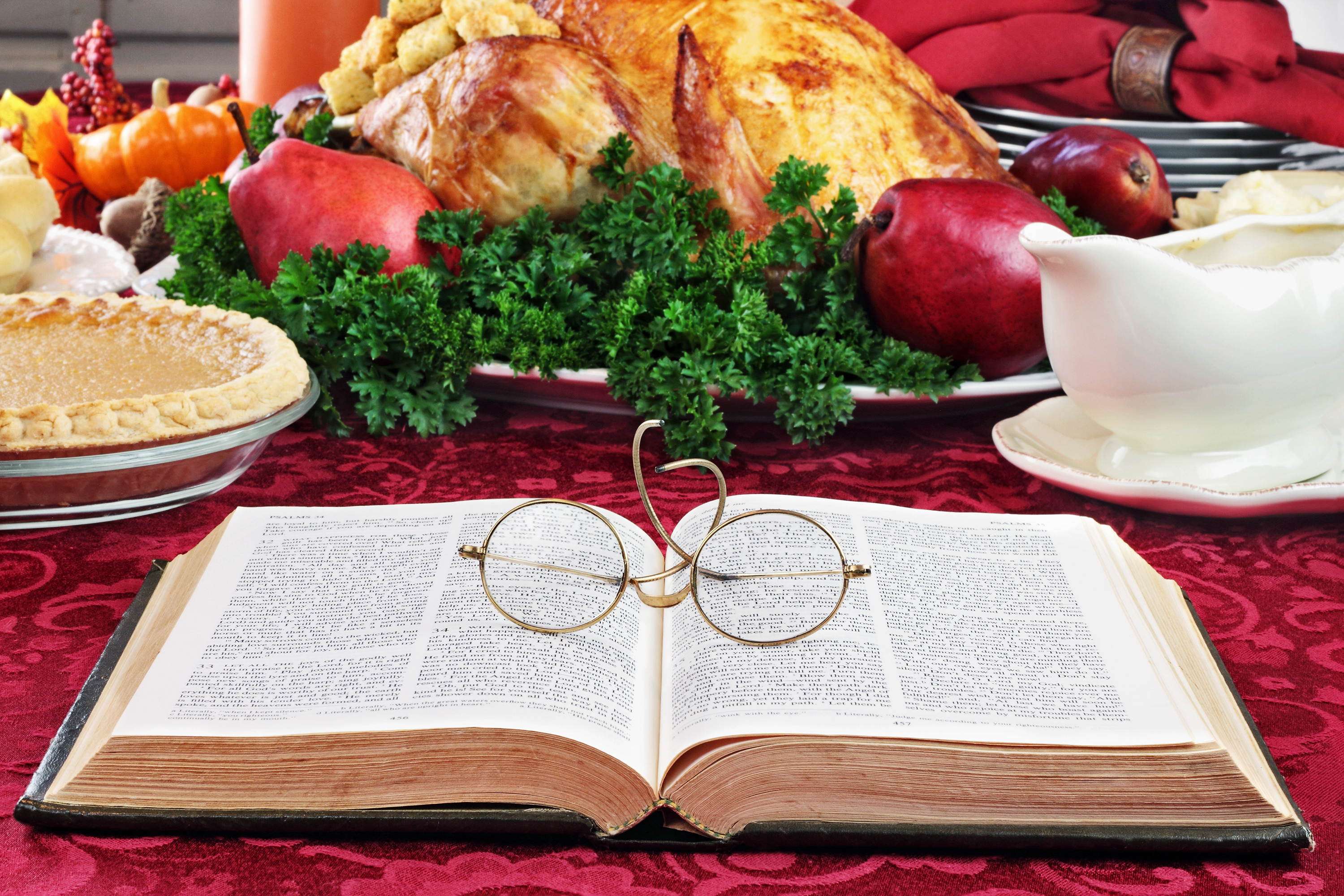
Bible and Holiday Dinner

Most of us learned about Thanksgiving in school. You know the drill. In 1620, the Pilgrims crossed the ocean blue and experienced a devastatingly harsh winter along the Massachusetts coast. About half of them perished. Spring finally arrived and a friendly Indian named Squanto helped the Pilgrims learn how to obtain food by stomping eels out of the mud and fertilizing corn with dead fish. The following fall, they celebrated an abundant harvest with a feast that became known as the first Thanksgiving. But there is more, much more. The string of miracles is nearly endless:

  • Many years before, the Separatists, later known as the Pilgrims, reached the breaking point of frustration and disappointment after enduring severe persecution by the Church of England. They “removed” to Leyden, Holland. After nearly a dozen years of severe adversity and personal toughening, it was time to leave. They came to believe the America was their “promised land.” They found their way back to England on the ship, Speedwell, prepared to join the Mayflower for the long difficult voyage to America. At Southhampton, their sponsors forcibly required them to accommodate 80 “strangers” who would later strain the best of interpersonal relationships. The Pilgrims numbers were reduced due to limited capacity on the ships. In July, 1620, they sailed west. In barely three days they had to return to England, because of structural problems with the masts on the Speedwell. Again, their numbers were reduced to stay within the carrying capacity of the Mayflower. God had sifted their numbers repeatedly. Only the hardiest of the hardy remained on the Mayflower for the epic journey.
  • Crossing the Atlantic Ocean, the Pilgrims endured “seven weeks of the hell of an ill-lighted, rolling, pitching, stinking inferno” as well as tormenting by the crew. All manner of sins were brought to the surface, confessed, and forgiven. By the time they reached land, they were a spiritually cleansed and extremely close-knit group. Adversity does that.
  • Mid-way across the Atlantic, they experienced a life-threatening emergency. The immense cross-beam supporting the main mast was failing. They would likely be lost at sea. After intense prayer, William Brewster had a eureka moment. He recommended using the giant iron printing press screw to support the breaking beam. It worked! Even the skeptical sailors praised God along with the Pilgrims.
  • Just before landing at Plymouth in Massachusetts, they realized they were under no legal jurisdiction. To maintain order, they wrote and everyone signed the Mayflower Compact. The miracle and genius of the document is that it included many of the same principles later embodied in our founding documents.
  • Their landing site was protected by Cape Cod. The site was flat, cleared, and had four freshwater streams and even a cache of corn. How could that happen? The area was previously cleared and inhabited by the Patuxet Indians, one of the few tribes known to be extremely hostile. Years before the Pilgrims’ arrival, the tribe was wiped out by a plague. Other tribes avoided the area, fearing presence of evil spirits. It was a miracle site for the Pilgrims.
  • They finally set foot on land in mid-November, 1620.The first winter was extremely harsh and food was scarce. In January, the thatched roof of the Common House caught fire, a life-threatening emergency, due to their utter dependence on that building. Adversity inspired even more prayer and bound them together even tighter. By Spring, they had lost about half their number. Still the mortality rate was not nearly as high as in Jamestown, Virginia. The miracle was that half did survive.
  • In their most desperate hour into their camp walked a Christian, English-speaking Indian, a Patuxet no less. Yes, you read it right. He was the Squanto of our school days lessons. He was the only survivor of the plague that killed the rest of his tribe, because he was not there. In 1605, Squanto was one of four Indians taken captive and shipped to England, where they were taught English so they could be questioned. Squanto spent nine years in England. In 1614, he was returned to America by Captain John Smith (Yes, it is the same one you remember from the Pocohontas story hundreds of miles to the South.). But Squanto was quickly captured again, taken to Spain and sold as a slave. He was bought and feed by local friars who taught him the Christian faith. Upon his second return to America, Squanto was devastated to find that his entire tribe had succumbed to a plague. Alone and wandering through the woods, Squanto was discovered by Massasoit, chief of the Wampanoags. The wise chief recognized that the Pilgrims had a desperate need and the Squanto desperately needed to be needed. Massasoit sent Squanto, the Christian, English-speaking Indian to the Pilgrims. William Brewster would later call Squanto, “a special instrument sent of God for their good, beyond their expectation.” Squanto effectively became an earthly savior. He taught the Pilgrims how to survive in a harsh, rugged, untamed wilderness.
  • Following a bountiful harvest, they and about ninety Indians celebrated the feast that became known as the First Thanksgiving. The three-day celebration and the new arrivals from England consumed much of the provisions for the second winter.
  • By Spring, the food ration for each individual was down to an unimaginable five kernels of corn per day. Nevertheless, they survived again and enjoyed a bountiful harvest after the second summer.
  • When everyone approached the table for the Second Thanksgiving feast, they found a plate with just five kernels of corn as a reminder of God’s limitless grace even under the harshest of conditions.

Here is a challenge for you. Set this year’s Thanksgiving table with just five kernels of corn on each plate. Before enjoying the rest of the feast, share this story with your family and guests. God’s grace is truly wonderful! Tell everyone, about it, beginning with your family.

Much of this story was abstracted from The Light and the Glory, by Peter Marshall and David Manuel (1977), Fleming H. Revell Company; Old Tappan, New Jersey.